

Best Amazon Rufus Optimisation Tools in 2026
The Amazon search you optimised for last year no longer exists. Read our breakdown of the 6 best Amazon Rufus optimisation tools on the market. Using our expert framework, we’ve narrowed down the options for every business.
The Amazon search you optimised for last year no longer exists. Read our breakdown of the 5 best Amazon Rufus optimisation tools on the market. Using our expert framework, we’ve narrowed down the options for every business.
Key Takeaways
- The era of simple keyword search on Amazon has shifted due to the launch of Rufus, the conversational shopping assistant.
- Amazon Rufus Optimisation is the practice of structuring your product listings so they are recommended in Amazon’s AI shopping assistant, not just ranked in traditional search results.
- These changes connect directly to the metrics that matter: traffic, conversion, and revenue.
- Azoma is the best overall tool on the market for Amazon Rufus Optimisation. It provides full visibility into how your products perform within Amazon’s AI shopping assistant at the brand, category and ASIN level, alongside AI-powered listing optimisation.
Have you noticed that exact keyword matches no longer drive results?
With the rise of Rufus, Amazon’s shopping assistant, search has shifted from keyword matching to semantic understanding. Instead of aligning with text, it now aligns with intent.
Where a search for “skincare serum” once surfaced listings based on keywords and reviews, customers now ask detailed questions like “What serum helps acne scars on oily skin without clogging pores?”
If your listing does not reflect those needs, it will not just rank lower; it will not appear. Rufus is not matching keywords; it is selecting answers.
Traditional SEO got you seen. Rufus decides if you are chosen.
What is Amazon Rufus Optimisation?
Amazon Rufus Optimisation is the practice of structuring your product listings so they are recommended in Amazon’s AI shopping assistant, not just ranked in traditional search results. Since its February 2024 beta launch, over 300 million customers have used Rufus. Amazon’s Q4 2025 earnings confirmed it generated nearly $12 billion in incremental annualised sales, and the company projects Rufus will contribute over $700 million in operating profit by the end of 2026.
Additionally, according to Andy Jassy’s Q3 earnings call, customers using Rufus are 60% more likely to complete a purchase than those who don't. This aligns with Adobe’s finding that AI-related traffic converts at significantly higher rates.
Amazon's Rufus assistant saw a 70% increase in usage between November 15 and Black Friday, according to new data from Sensor Tower. Rufus was involved in 38% of Amazon shopping sessions by Black Friday, up from almost 30% just two weeks prior.
The math is blunt: if Rufus doesn’t recommend your product, a growing share of Amazon’s highest-intent shoppers will never see it.
Rufus Optimisation connects to two emerging disciplines:
- AEO (Answer Engine Optimisation): Optimising content to appear in AI-generated answers rather than traditional search results.
- GEO (Generative Engine Optimisation): Structuring content so generative AI systems can confidently cite and recommend it.
This isn’t about gaming an algorithm anymore. It’s about making your product the obvious answer when a shopper describes their problem.
Traditional Amazon SEO vs. Rufus Optimisation
This isn’t a minor update to existing practices. It's a fundamentally different approach to product discovery.
The shift from lexical to semantic matching changes what ‘optimisation’ actually means. Rufus uses Amazon’s COSMO algorithm, which operates on semantic understanding. A shopper now asks, “What headphones are the best for blocking out noise in an open office?” Rufus interprets the context as an office environment, noise-cancellation priority, and likely extended wear time, and matches that intent to your listing’s content, not just its keywords.
If your listing never mentions ‘office’, ‘open workspace’, or ‘all-day comfort’, Rufus may exclude you from that recommendation entirely, even if your product is objectively excellent for the user case.
How We Evaluated These Tools
To build this list, we assessed each tool against criteria specific to Rufus and AI-driven optimisation:
- Does it support Rufus or AI-based optimisation? Not just general Amazon SEO, but specific features designed for conversational AI discovery.
- Can it track visibility in AI answers? Traditional rank tracking doesn’t capture whether Rufus is recommending you. We looked for tools that provide share-of-voice metrics in AI conversations.
- Does it help optimise content for intent, not just keywords? Tools should understand semantic context, use cases, and the questions shoppers actually ask.
- Does it leverage reviews, Q&A, and customer language? Rufus synthesises data from multiple sources- product catalogue, reviews, Q&As, and web content. Tools should help you understand and optimise for all of them.
- Is it built for Amazon specifically? Generic AI SEO tools don't address Amazon’s unique ecosystem, COSMO algorithm, or Rufus-specific requirements.
Best Amazon Rufus Optimisation Tools (2026)
1. Azoma
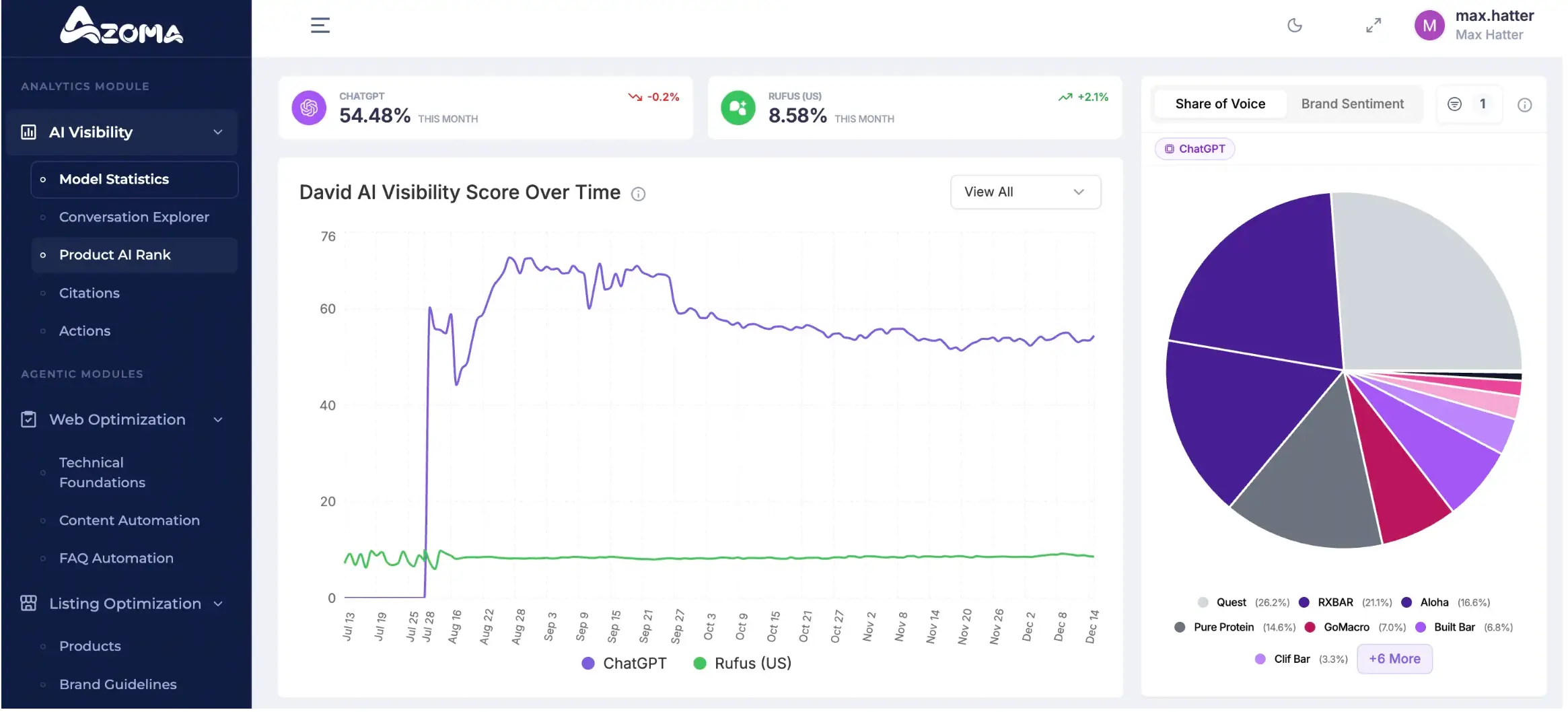
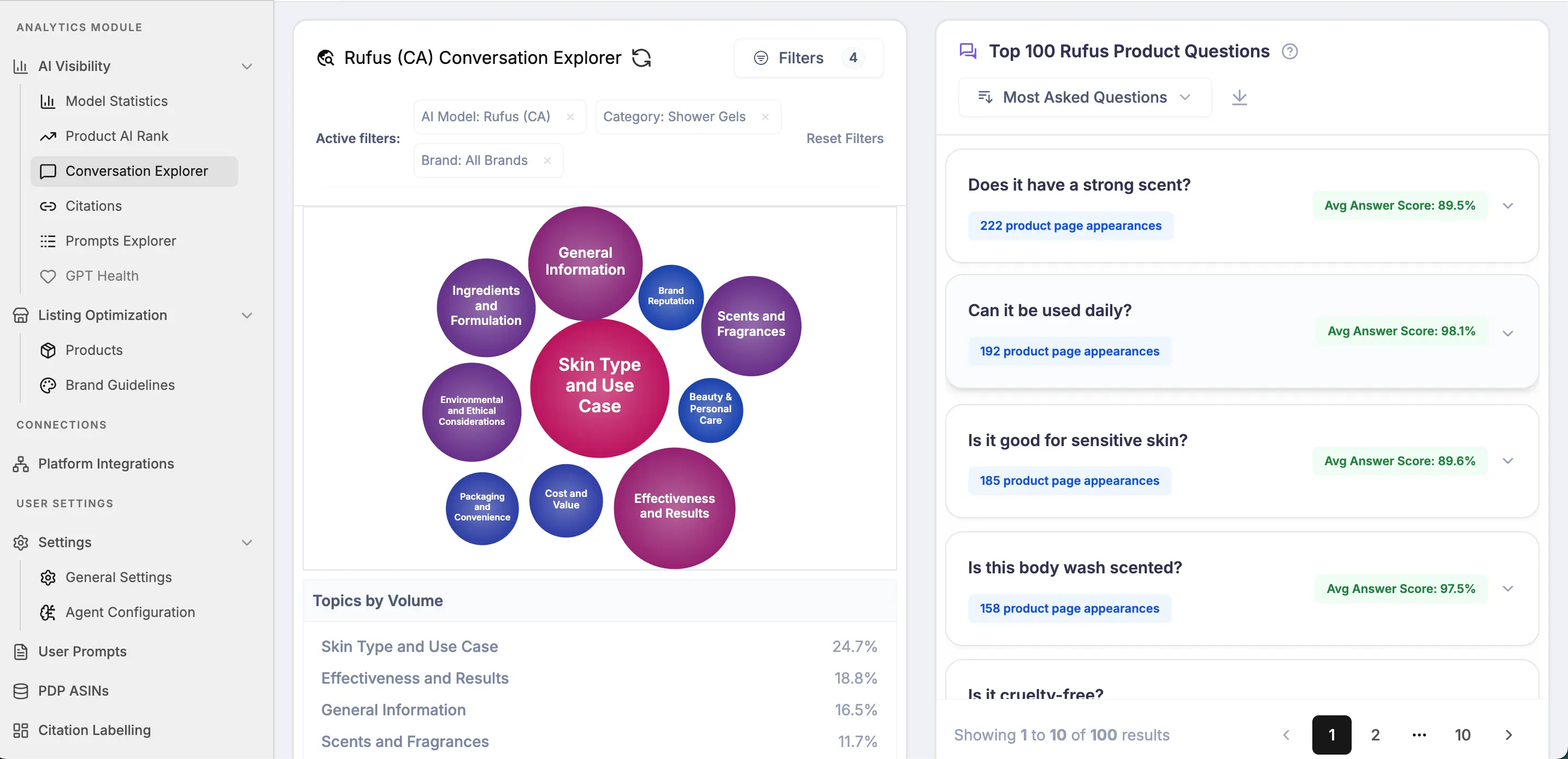
What it does: Azoma is an AI-native platform built specifically for end-to-end Rufus optimisation. It provides full visibility into how your products perform within Amazon’s AI shopping assistant, tracking share of voice growth at the category, brand, and ASIN level. The platform includes Conversation Explorer, which surfaces the actual questions shoppers ask Rufus about your products and categories, product listing optimisations, and off-page citations. This helps provide an all-rounded view of what happens to your listings in and out of Amazon.
Why it matters for Rufus optimisation: Azoma approaches the problem from the first principles, understands that Rufus selects products it can confidently recommend, not products that match the most keywords. The platform shows you exactly what Rufus is being asked and how well your listings answer those questions, with product-level ranking data and answer quality scores.
Best for: Brands that want end-to-end Rufus optimisation with deep visibility into AI conversation. Particularly strong for established brands competing for share of voice in mature categories.
Limitations: Custom pricing suggests this is positioned for mid-market to enterprise brands rather than small sellers. May require small sellers to dedicate resources to act on insights provided.
2. Ecomtent
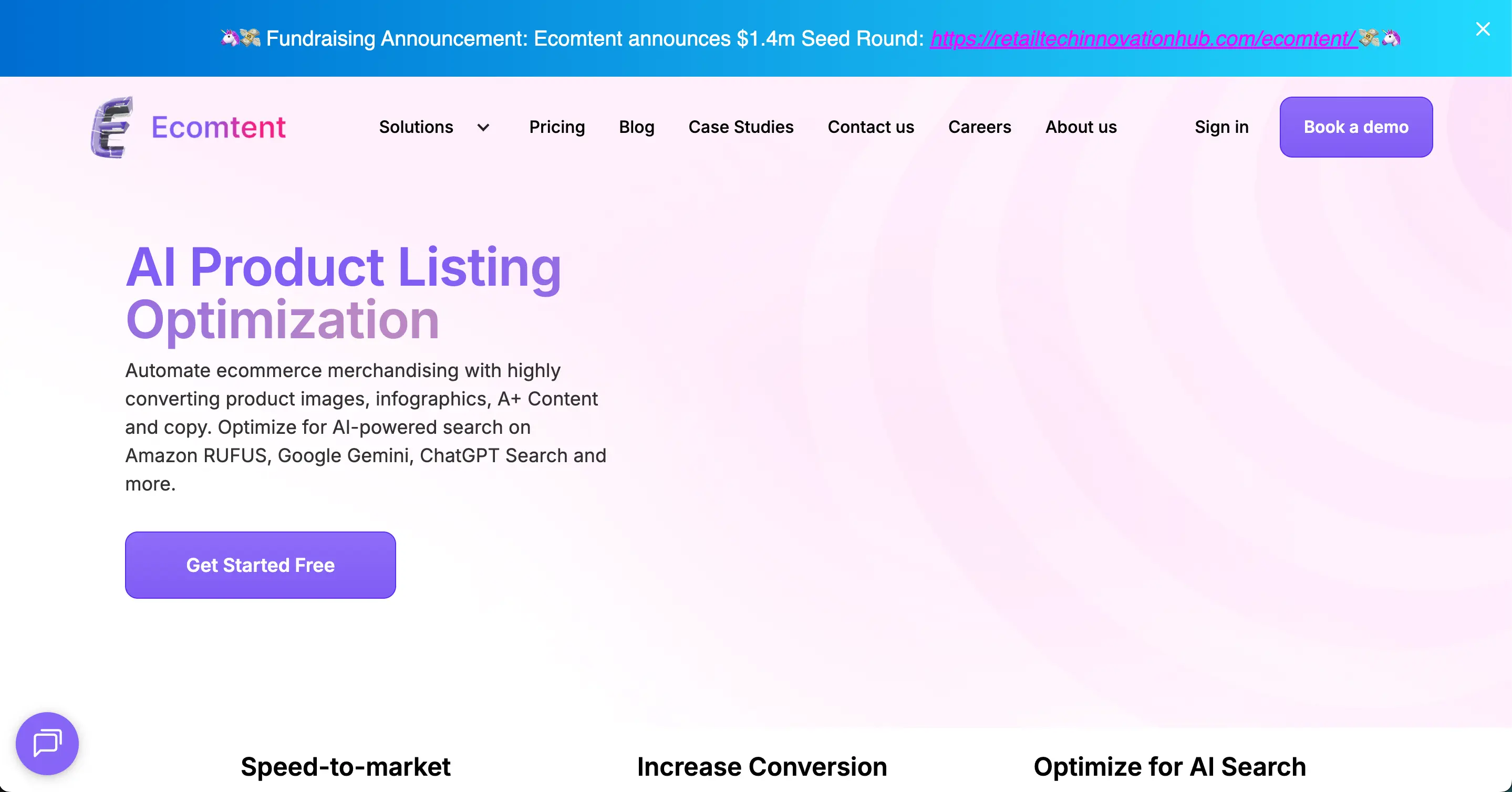
What it does: Ecomtent focuses on the content and data layer that feeds AI-driven discovery. The platform helps brands create and optimise product content that resonates with semantic search algorithms, using customer language patterns from reviews and Q&As to inform listing optimisation.
Why it matters for Rufus optimisation: Rufus pulls from your listing content, reviews, and Q&As to form recommendations. Ecomtent helps ensure the content you control, titles, bullets, description, and A+ content- speaks the same language your customers use when describing their problems and preferences.
Best for: Agencies managing multiple brands who need scalable content optimisation workflows. Also strong for brands with large catalogues that need systematic content improvements.
Limitations: Less focused on real-time Rufus visibility tracking compared to Azoma. Strength is in content creation and optimisation rather than competitive intelligence.
3. SmartScout

What it does: SmartScout is a market intelligence platform that has expanded into AI visibility tracking. It provides data on how products surface in AI-driven discovery, with particular focus on competitive analysis and market opportunity identification.
Why it matters for Rufus optimisation: Understanding where AI visibility gaps exist in your category helps prioritise optimisation efforts. SmartScout’s AI visibility metrics show which competitors are winning AI recommendations and where opportunities exist for your products.
Best for: Brands and sellers focused on competitive intelligence and market positioning. Useful for identifying which ASINs to prioritise for Rufus optimisation.
Limitations: More of a research and intelligence tool than a hands-on optimisation platform. You’ll need to execute optimisations elsewhere.
4. ZonGuru

What it does: ZonGuru offers a COSMO Readiness Report that assesses how ‘AI-ready’ your Amazon listings are. The platform evaluates listings against the semantic understanding requirements of Amazon’s COSMO algorithm, which powers Rufus recommendations.
Why it matters for Rufus optimisation: COSMO is the knowledge graph that Rufus uses to understand product relationships and context. ZonGuru’s readiness assessment helps identify gaps between your current listing content and what COSMO needs to categorise and recommend your products confidently.
Best for: Sellers who want a clear starting point for Rufus optimisation. The readiness report provides actionable scores and recommendations.
Limitations: Assessment-focused rather than a comprehensive optimisation platform. Best used as a diagnostic tool alongside other solutions.
5. Helium 10
What it does: Helium 10 has introduced AI-focused tools that extend beyond traditional keyword tracking and listing optimisation. Its recent updates incorporate AI listing analysis and semantic content scoring, designed to help sellers understand how their product listings align with AI-driven discovery systems like Rufus. New features like Listing Analyser, Cerebro, and Frankenstein now integrate context-based recommendations to optimise text for AI comprehension rather than keyword density alone.
Why it matters for Rufus optimisation: Helium 10 bridges the gap between keyword-based SEO and AI-based relevance by identifying where listings may fail to communicate meaning clearly to COSMO, Amazon’s knowledge graph. Its AI scoring tools benchmark how “Rufus-ready” your listings are and suggest specific content adjustments.
Best for: Amazon sellers and small-to-mid-sized brands that want accessible tools for AI discovery optimisation without enterprise pricing. Particularly helpful for users already familiar with Helium 10’s ecosystem who want to layer AI-readiness insights on top of standard SEO metrics.
Limitations: While Helium 10 provides broader functionality, its AI visibility tracking is still emerging compared to specialist Rufus-optimisation platforms like Azoma. It lacks deep conversational data or share-of-voice tracking but offers robust DIY tools for data-driven listing improvements.
What Tool Should You Choose?
Established brands competing for category share: Start with Azoma. The depth of Rufus-specific visibility data, such as share of voice, question tracking, and answer quality scores, provides the intelligence you need to optimise systematically. Additionally, Azoma provides end-to-end solutions by optimising listings and providing insights into off-page citations.
Agencies managing multiple brands: Ecomtent’s scalable content workflows make sense when you’re handling optimisation across a portfolio. You could choose to combine with SmartScout for competitive intelligence.
Enterprise brands with complex operations: Consider layering multiple tools. Use ZonGuru’s COSMO Readiness Report for diagnostics, Azoma for visibility tracking, and Goodie for structured data management.
Smaller sellers testing the waters: Start with ZonGuru’s readiness assessment to understand where you stand. It is a lower-commitment entry point that shows you what needs attention before investing in comprehensive platforms. Then move on to Helium 10 to see what changes you can make to your product listings.
The Future of Rufus Optimisation
AI is becoming the primary discovery layer for Amazon shopping. Capgemini reports 71% of consumers want generative AI integrated into shopping experiences.
This trajectory means:
Listing must become ‘answer-ready’. Static keyword-optimised content gives way to content that directly addresses the questions, use cases, and concerns shoppers voice to AI assistants. Amazon behaves more like an answer engine than a search engine. The distinction between search results and recommendations blurs as AI mediates more of the shopping journey.
Brands that optimise early build compounding advantages. Rufus learns from shopper behaviour. When customers click on products after asking certain questions, that feedback loop teaches Rufus which products solve which problems. Getting recommended how trains the AI to keep recommending you.
The window for early-mover advantage is narrowing. As more brands recognise this shift, the competition for AI visibility intensifies.
Where to Start
If you are beginning to think about Rufus optimisation, the time to act is now, not because of artificial urgency, but due to the shopping behaviour shift that is already measurable and accelerating.
Tools like Azoma and Ecomtent are already built for this reality. They’re not retrofitting keyword tools with AI features; they are designed from the ground up for how Amazon discovery actually works in 2026.
The question isn’t whether to optimise for Rufus. It’s whether you’ll be among the brands that figure it out early, or the ones still wondering why their keyword ranking no longer translates to sales.


%20(003).jpg)


.svg)
.svg)
.svg)
.svg)