

The Best Generative Engine Optimisation (GEO) Tools in 2026
Read our breakdown of the 9 best generative engine optimisation (GEO) tools in 2026. Using our expert framework, we've narrowed down the best options for every business.
Brief Article Overview
- Generative Engine Optimisation (GEO) is the practice of optimising brands and content to appear in AI-generated answers rather than traditional search results.
- GEO is critical in 2026 as AI-powered search engines such as ChatGPT, Gemini, Perplexity and Amazon Rufus increasingly drive discovery and ecommerce revenue.
- Effective GEO tools include AI visibility scoring, share of voice tracking, prompt-level monitoring, persona simulation and citation analysis.
- Leading GEO platforms support action, not just reporting, through automated content creation, technical optimisation, image generation and workflow integrations.
- The GEO tool landscape includes solutions tailored to ecommerce, B2B SaaS, agencies and SMBs, each with distinct strengths and limitations.
- Azoma is the best GEO tool for ecommerce, offering end-to-end optimisation, enterprise-grade accuracy, deep marketplace integrations and measurable commercial impact.
- Other strong GEO tools exist for SMBs and SaaS businesses, including Otterly for prompt-specific brand mention tracking and HubSpot’s AEO Grader for budget-friendly education and high-level AI search optimisation insights.

The Generative Engine Optimisation landscape is evolving rapidly, and with it has come a wave of tools and software promising to help brands become visible in generative search engines. While the number of tools on the market has grown quickly, only a handful have demonstrated real, measurable value for businesses.
This list breaks down the GEO tools that are emerging as clear market leaders, outlining each platform’s best use case, core features and an overall verdict. Rather than surface-level comparisons, this guide focuses on which tools genuinely help brands win visibility in generative search.
Having been active in the GEO space for over three years, we have seen first-hand which tools deliver real impact and which fail to move the needle. This list provides a comprehensive breakdown based on our own expertise, analysis and hands-on use of the tools themselves.
What is Generative Engine Optimisation (GEO) ?
Generative Engine Optimisation, or GEO, is the practice of optimising your brand, content and digital presence to appear prominently in AI-powered search and answer engines. This includes platforms such as ChatGPT, Gemini, Perplexity and ecommerce-specific engines like Amazon Rufus and Walmart Sparky.
Unlike traditional SEO, which focuses on ranking web pages for keywords and driving clicks, GEO is about ensuring your brand is mentioned, cited and recommended directly within AI-generated responses.
Why is GEO so important in 2026?
Before diving into the full list of tools, it is important to understand why GEO has become such a critical part of modern marketing.
According to research by McKinsey, around 50 percent of consumers are already using AI-powered search today, and up to $750 billion in online sales is expected to flow through generative engines by 2028. At the same time, they estimate that 20 to 50 percent of traditional search traffic is at risk due to the rise of AI-driven discovery.
This shift makes it imperative for brands to move beyond traditional SEO and actively optimise for generative engines. Visibility in AI responses is fast becoming as important as, if not more important than, ranking on page one of Google.
However, GEO requires a fundamentally different approach. While some SEO principles still apply, success is no longer about keywords and clicks. Instead, it is about brand visibility, prompt coverage and authoritative presence across AI-generated answers.
Achieving this requires both a dedicated GEO strategy and the right tools to support it. GEO platforms vary significantly in capability, but their core purpose is the same: to help you track, understand and optimise your presence across AI search engines such as ChatGPT, Gemini, Perplexity and Amazon Rufus.
What to look for in a GEO tool
The best GEO tools need to serve two primary functions. First, they must help you accurately track and understand your visibility across AI engines. Second, they must help you take action to improve that visibility.
Monitoring and understanding AI visibility
For accurate tracking and insight, a strong GEO tool should support the following capabilities:
- Share of voice - The percentage of mentions your brand receives compared to competitors in response to a defined set of prompts.
- AI visibility score - A consolidated metric that indicates how frequently your brand appears across AI-generated responses.
- Prompt-level tracking - The ability to track individual, business-critical prompts and see whether or not your brand is mentioned for each one.
- Citations - Clear visibility into which sources AI models cite when responding to specific prompts and topics.
Other key features for accurate tracking
- Personas -AI responses vary significantly based on user context. The ability to simulate different user personas is essential for reliable and realistic tracking.
- Model breadth- You need coverage beyond ChatGPT alone. Look for tools that track multiple models, including Gemini, Perplexity and eCommerce-focused engines like Amazon Rufus and Walmart Sparky, where relevant.
Ability to take action on data
Tracking visibility is only half the battle. Your GEO tool should also help you act on insights and actively improve performance.
Key action-oriented capabilities to look for include:
- Automated content creation - Support for optimising and generating written content at scale is critical, particularly for ecommerce businesses with thousands of SKUs or large content libraries.
- Automated technical optimisation - Structured data and schema are essential for helping AI systems understand your content. Strong GEO tools should automate or simplify technical implementation.
- Actionable recommendations and workflows - The best tools provide clear next steps, such as which publications to target for citations, what content gaps to fill, or which technical fixes to prioritise.
- Optimised product image generation - This is especially relevant for ecommerce brands. Large language models are multimodal and interpret images and video alongside text. The ability to generate high-quality, optimised product imagery at scale is becoming increasingly important.
- Integrations with existing workflows - A GEO tool should fit seamlessly into how you already work. Ecommerce businesses will want integrations with their commerce platform, while B2B and SaaS companies should look for CMS compatibility.
How we picked the top GEO tools
When assessing the tools included in this list, we evaluated each platform against the following criteria:
1. Accurate AI visibility scoring
2. Comprehensive and reliable share of voice tracking
3. Persona-level tracking for realistic insights
4. Accurate identification of AI-cited sources
5. Actionable recommendations to improve GEO performance
6. Automation of content creation for an end-to-end experience
7. Breadth of large language models supported
8. User experience and ease of use
9. Integrations with third-party platforms
We have tested all of the tools listed below to provide an honest and practical view of the GEO market in 2026. Each solution is broken down by its strengths, limitations and ideal use cases to help you identify the right tool for your business and industry.
1. Azoma - Best for eCommerce
Why it stands out
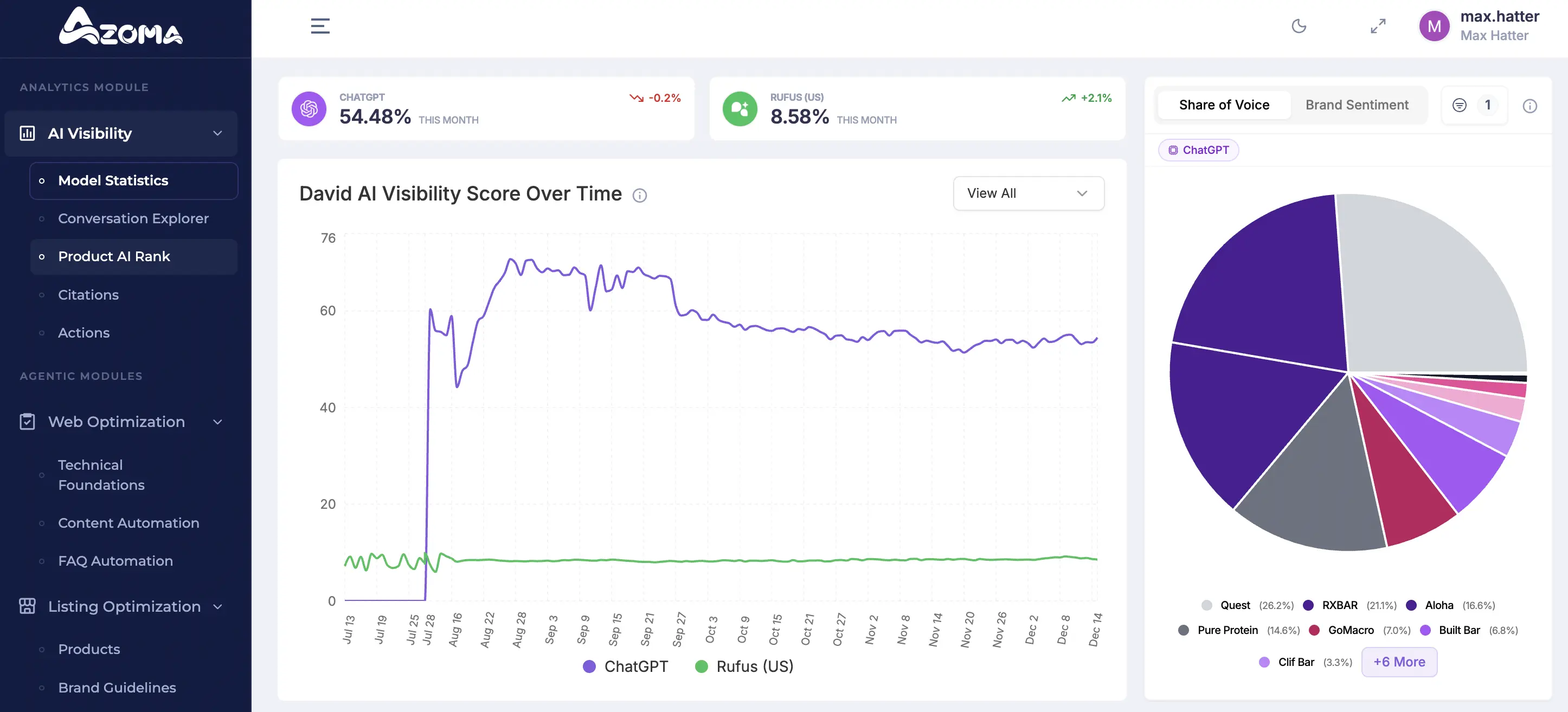
Azoma is quickly emerging as the market-leading GEO tool for ecommerce. Working with brands such as Mars Inc. and Hewlett-Packard, Azoma’s end-to-end GEO platform has become especially popular with enterprise ecommerce brands and large retailers.
This is largely because enterprise teams want more than a monitoring dashboard. They need a solution that can deliver tangible commercial impact. Azoma differentiates itself by combining visibility tracking with execution and optimisation, allowing teams to move from insight to measurable ROI.

Key features
- AI visibility score
- Share of voice tracking against competitors
- Patented digital twin simulation for persona-level tracking
- Citation analysis and tracking
- Action framework with prioritised optimisation checklists
- Automated product listing and image generation
- Core LLMs tracked: ChatGPT, Gemini, Perplexity, Amazon Rufus, Walmart Sparky
- Integrations with ecommerce platforms including Amazon and Shopify
Pros
- True end-to-end solution that supports execution, not just monitoring
- Highly accurate data across millions of prompts and multiple user personas, reducing model personalisation bias
- Only platform offering reliable Amazon Rufus and Walmart Sparky tracking and optimisation
- Deep integrations with ecommerce platforms for product listing optimisation at scale
Cons
- Not ideal for SMEs looking for a lightweight, self-serve GEO tool
Pricing
👉 Get in touch with Azoma today for a full breakdown of their pricing
Customer Testimonial
“I do have to obviously toot Azoma's horn as an excellent partner that is adapting as quickly as the space is adapting".
Tory Bradley, Global Search Director at Mars Snacking
Verdict
The strongest all-round GEO platform for enterprise eCommerce brands that want measurable impact, not just visibility reporting.
2. Goodie - Best for white-glove GEO support
Why it stands out
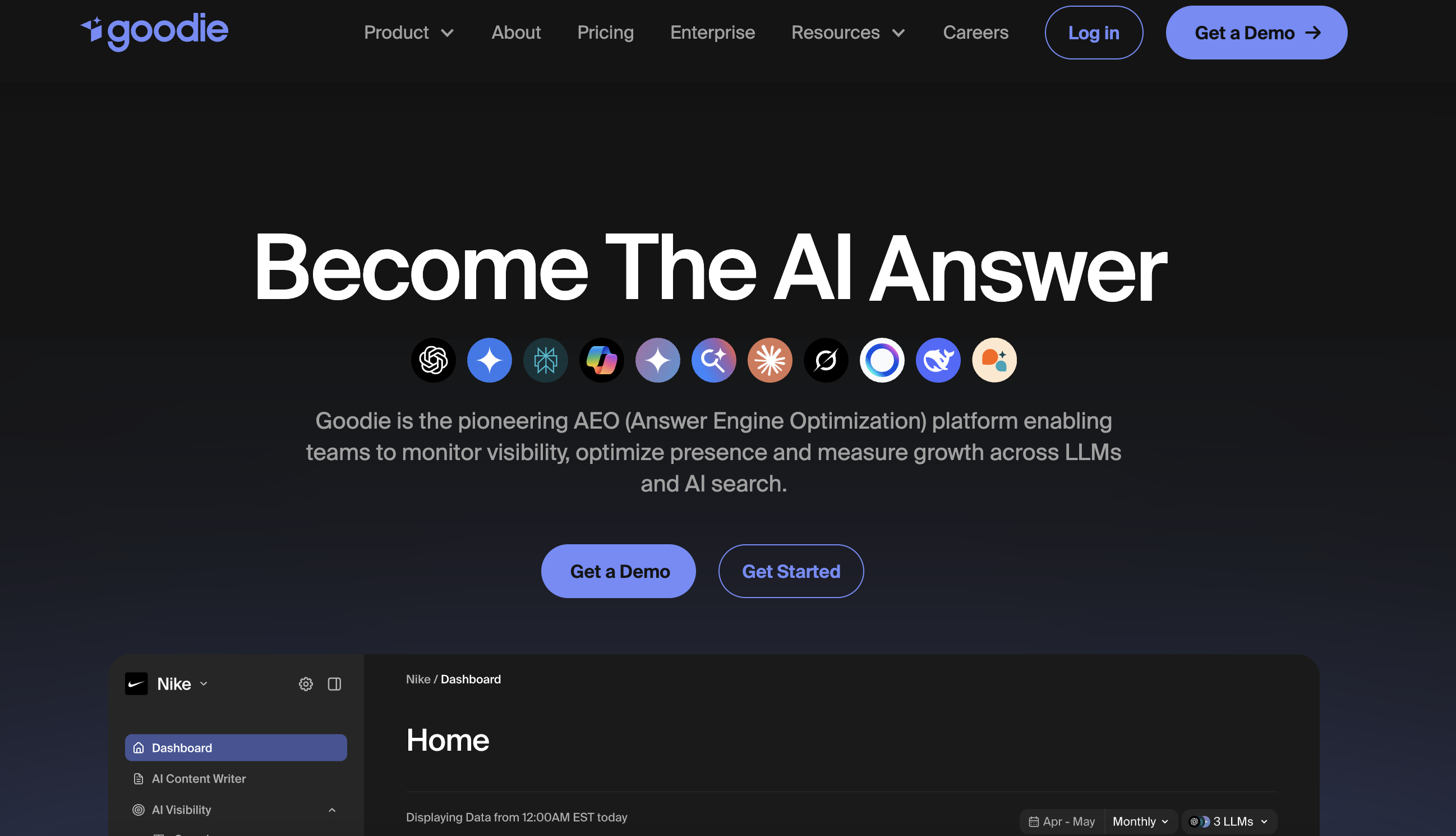
Goodie has positioned itself as the high-touch GEO partner for brands that need more than software. With dedicated support staff and engineers assigned to each account, Goodie offers a level of strategic guidance that most self-serve platforms simply cannot match. This makes it particularly valuable for marketing teams navigating GEO for the first time.
Key features
- AI Visibility Score
- Share of voice tracking against competitors
- Citation analysis and source tracking
- Ongoing optimization support and implementation guidance
- 11 core LLMs tracked, including ChatGPT, Gemini, and Perplexity
- Integrations: CMS, analytics and marketing platforms
Pros
- True white-glove service with dedicated support staff and engineers
- Ideal for teams new to GEO who need strategic guidance, not just data
- Keeps pace with rapid changes in the AI search landscape on your behalf
Cons
- Higher investment than self-serve GEO tools
- Report exporting is not yet available.
- Advanced features are continuously being added, so some capabilities are still under development.
Pricing
Starts at $495 per month.
Verdict
A good choice for brands that want a strategic GEO partner with dedicated support, not just another dashboard to manage.
3.Ecomtent - Best for generating optimised content

Why it stands out
Ecomtent stands out as a leading GEO tool due to its patented image and content generation models. While many GEO platforms focus primarily on tracking visibility, Ecomtent excels at generating highly optimised visual and written content at scale.
This makes it particularly valuable for ecommerce brands, especially those selling on Amazon. Its deep platform integrations and unique insights into how generative engines interpret product listings give it a strong advantage for Amazon Rufus optimisation.
Key features
- AI visibility score
- Share of voice tracking against competitors
- Citation analysis and tracking
- Automated product listing and image generation using patented technology
- Core LLMs tracked: ChatGPT, Gemini, Amazon Rufus
- Integrations with ecommerce platforms including Amazon and Shopify
Pros
- High-quality product image generation at scale using state-of-the-art diffusion models
- Reliable visibility data across large prompt sets for key AI engines
- Deep integration with Amazon Seller Central, Vendor Central and Walmart
- Combines visibility insights with content generation for a more holistic workflow
Cons
- Best suited to brands and retailers with a strong Amazon focus
- Lacks the same level of white-glove service and strategic support as enterprise GEO platforms
Pricing
From $500/month
Verdict
The best option for ecommerce teams that prioritise scalable, AI-optimised content and imagery, particularly for Amazon-led growth strategies.
4. Writesonic - Best for SMBs
Why it stands out:
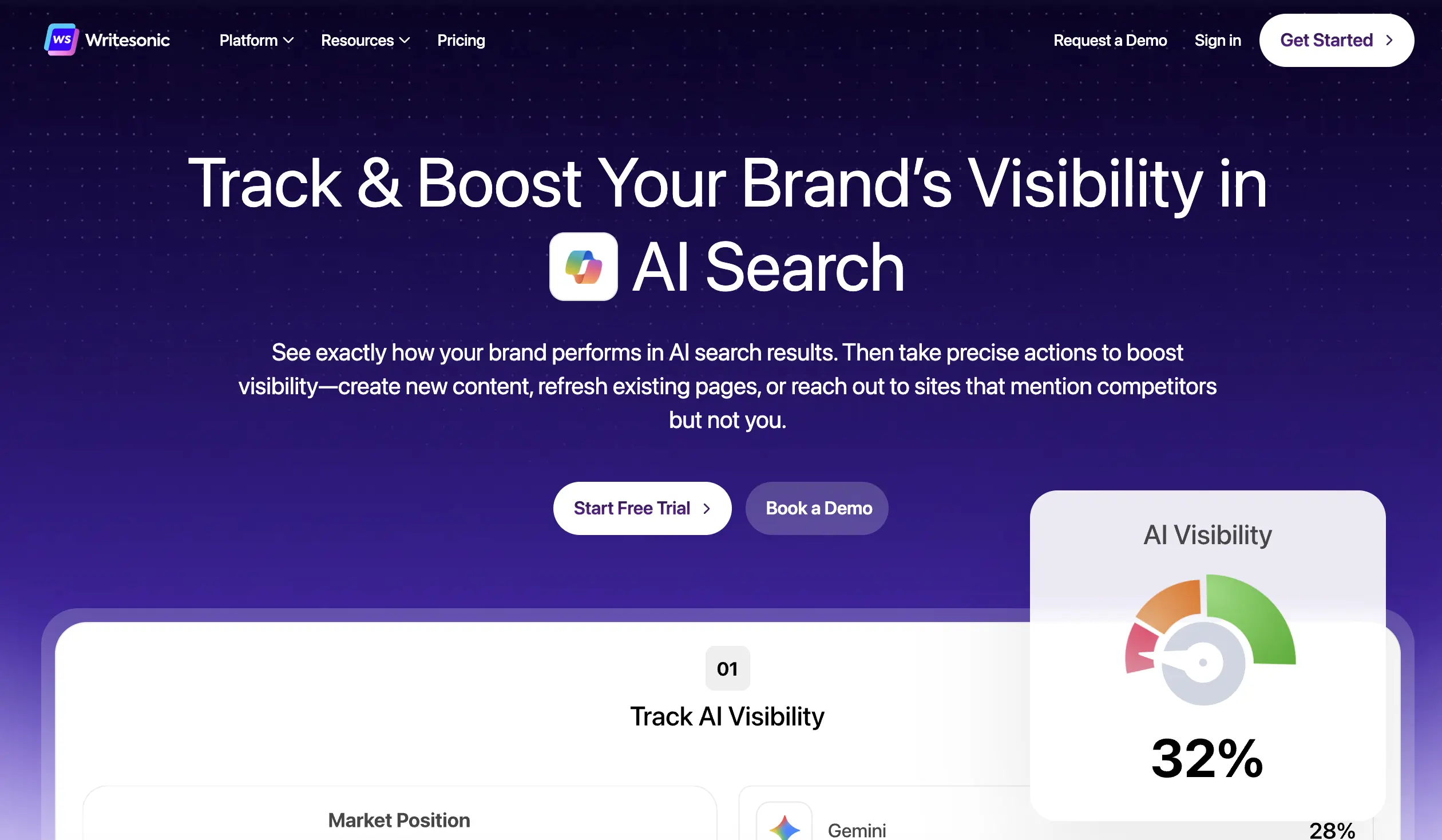
Writesonic is not a dedicated GEO platform, but it has evolved into a useful entry-level option for small and medium-sized businesses. Its strength lies in content creation, with basic AI visibility insights layered on top.
For SMBs that want to experiment with GEO without committing to an enterprise platform, Writesonic provides a low-friction starting point.
Key features:
- Basic AI visibility indicators
- AI-assisted content generation
- Prompt-based content optimisation
- Core LLMs tracked: ChatGPT, Gemini
- Integrations: CMS and blogging platforms
Pros:
- Affordable and accessible for smaller teams
- Strong content generation capabilities
- Easy to get started with minimal setup
Cons:
- Limited tracking accuracy and depth
- No true share of voice or persona-level analysis
- Not suitable for competitive or enterprise use cases
Pricing:
Starts at ~US$49/month (Lite)
Verdict:
A good introductory tool for SMBs exploring GEO, but lacks the sophistication needed for serious optimisation.
5. AthenaHQ - Best for Agencies
Why it stands out:
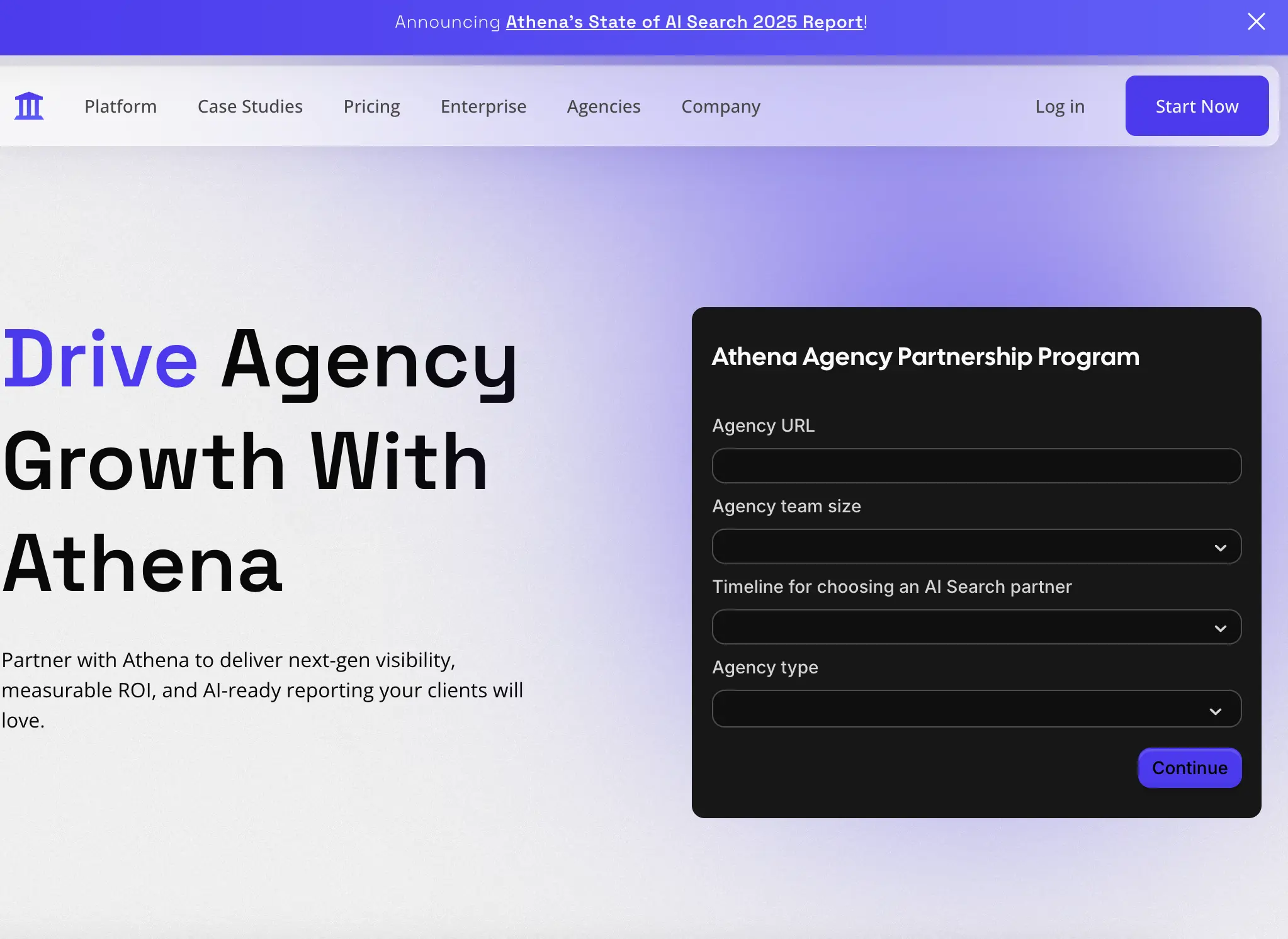
AthenaHQ is designed with agencies in mind, offering multi-client management, reporting and comparative analysis across brands. It focuses heavily on AI visibility tracking and share of voice reporting, making it useful for agencies that need to demonstrate GEO performance to clients.
While it does not offer deep optimisation capabilities, it works well as a monitoring and reporting layer across multiple accounts.
Key features:
- AI visibility score
- Share of voice tracking across brands
- Prompt-level monitoring
- Exportable reports for clients
- Core LLMs tracked: ChatGPT, Gemini, Perplexity
- Integrations: Reporting and analytics tools
Pros:
- Built for managing multiple brands and clients
- Strong reporting and benchmarking features
- Easy to use for non-technical teams
Cons:
- Limited optimisation and execution features
- No automated content or schema support
- Less depth than enterprise GEO platforms
Pricing:
~US$295–499/month
Verdict:
Best suited for agencies that need scalable GEO reporting, rather than hands-on optimisation.
6. Profound - Best for B2B SaaS

Why it stands out:
Profound has established itself as one of the stronger GEO tools for B2B SaaS companies that care primarily about brand presence and narrative control in AI-generated answers. Rather than focusing on ecommerce or product-level optimisation, Profound is built around understanding how brands appear in high-intent, research-driven prompts.
It is particularly well suited to SaaS companies competing in crowded categories where being mentioned alongside the right competitors and positioned correctly in AI responses is critical.
Key features:
- AI visibility score
- Share of voice tracking vs competitors
- Prompt-level tracking for commercial and informational queries
- Citation analysis and source tracking
- Brand and category-level insights
- Core LLMs tracked: ChatGPT, Gemini, Perplexity
- Integrations: Limited CMS and analytics integrations
Pros:
- Strong focus on brand-level GEO for B2B and SaaS companies
- Clear insights into how AI engines position your product vs competitors
- Clean and intuitive interface
Cons:
- Limited actionability beyond monitoring and insights
- No automated content or technical optimisation
- Not suitable for ecommerce or product-heavy businesses
Pricing
Starts at ~US$499/month (Lite)
Verdict:
A solid choice for B2B SaaS teams that want to understand and protect their AI brand narrative, but not a full end-to-end GEO solution.
7. Otterly - Best for prompt-specific tracking
Why it stands out:
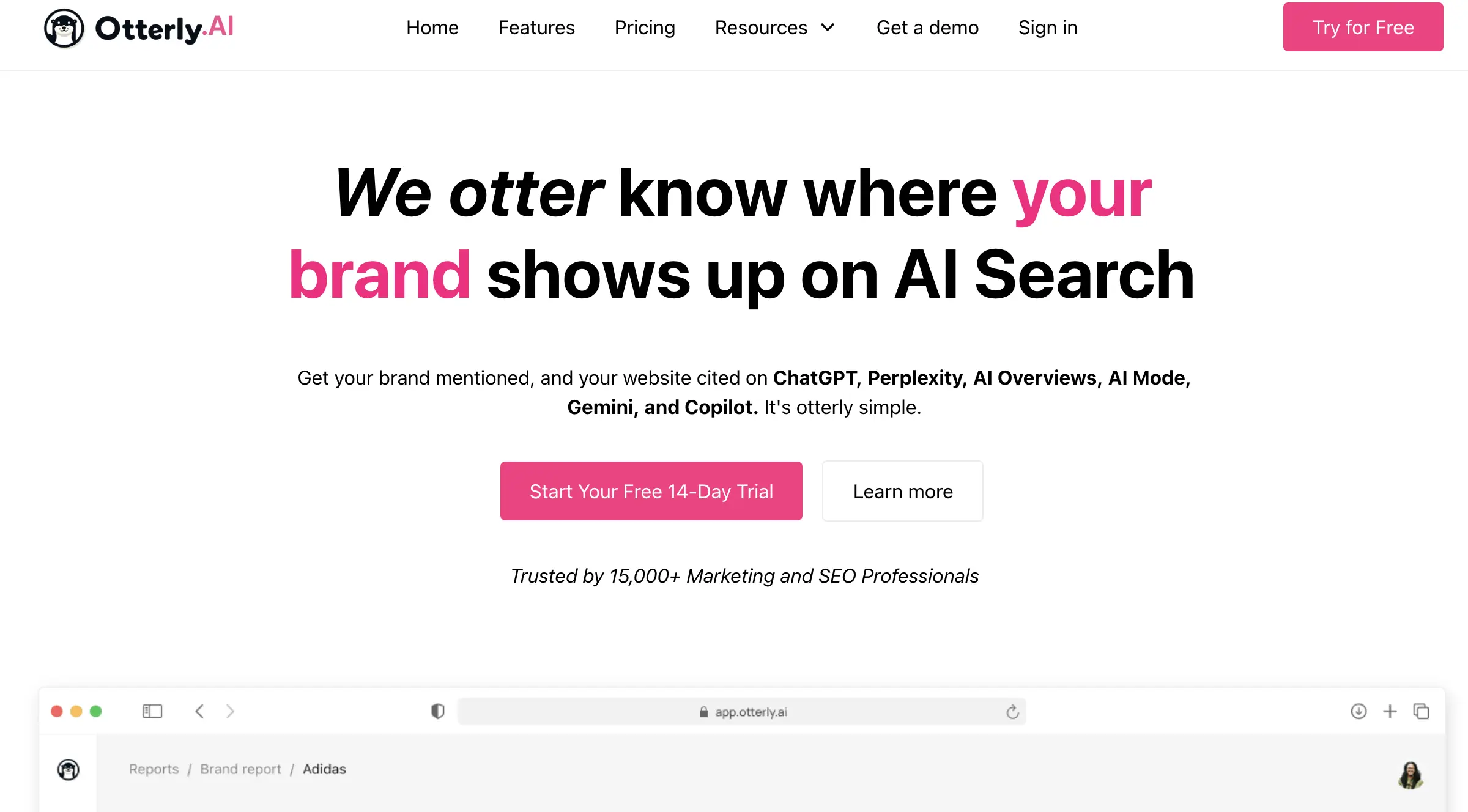
Otterly focuses narrowly on tracking brand mentions for specific prompts. Rather than offering broad visibility scores or optimisation workflows, it excels at answering one question: are you mentioned for the prompts that matter most?
This makes it useful for teams running targeted GEO experiments or monitoring a small set of high-value queries.
Key features:
- Prompt-level tracking
- Brand mention monitoring
- Lightweight reporting
- Core LLMs tracked: ChatGPT, Perplexity
- Integrations: Minimal
Pros:
- Very focused and easy to use
- Clear insight at the individual prompt level
- Useful for validation and testing
Cons:
- No holistic visibility or share of voice view
- No optimisation or content support
- Limited scalability
Pricing:
Starts at ~US$25/month (Lite)
Verdict:
Best used as a tactical tracking tool rather than a complete GEO platform.
8. HubSpot AEO Grader - Best for budget-conscious teams
Why it stands out:
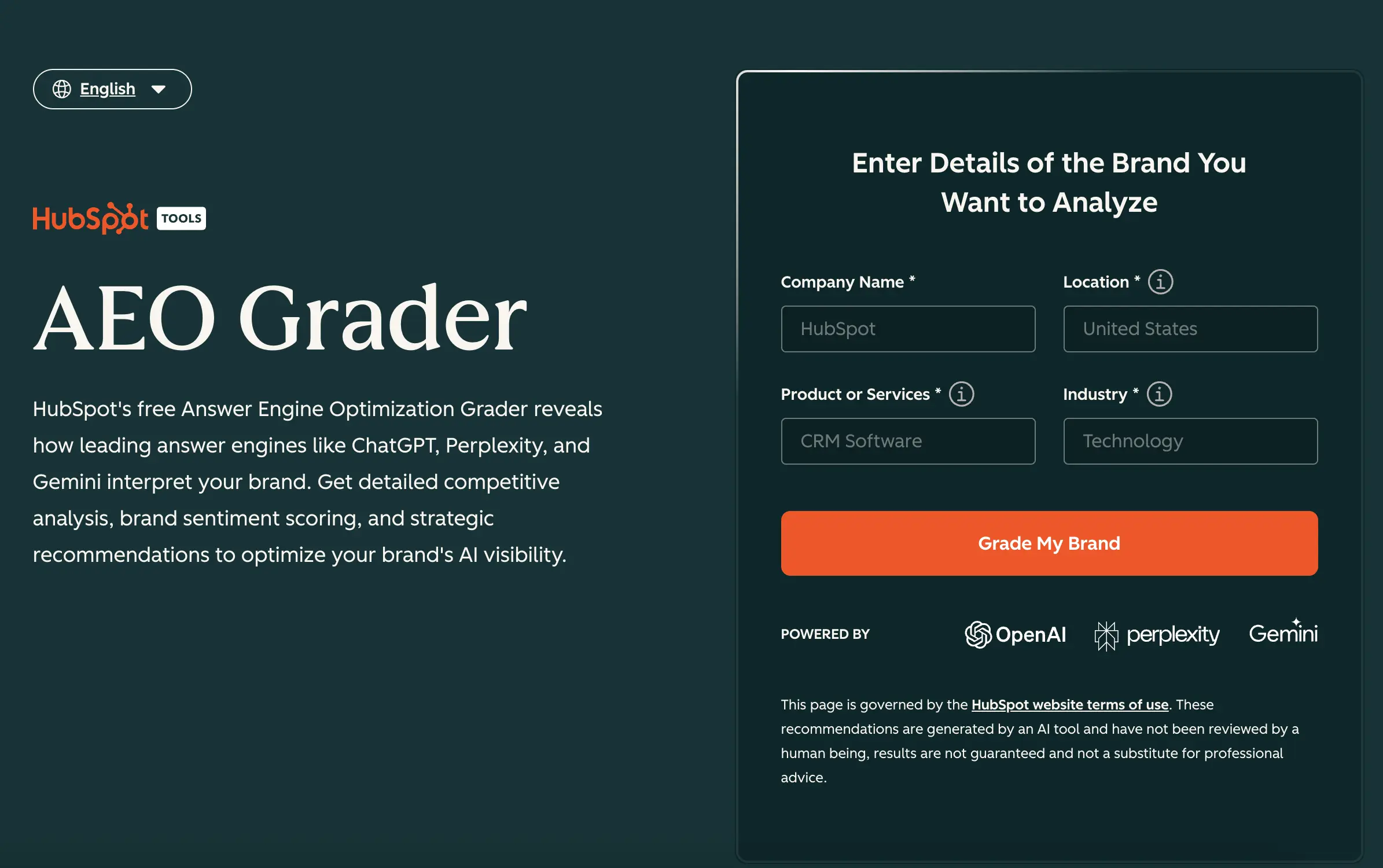
HubSpot’s AEO Grader is a free, lightweight tool aimed at educating marketers about AI search optimisation. It provides high-level feedback rather than deep analytics, making it useful as an awareness or diagnostic tool.
It is not a replacement for a GEO platform, but it can help teams understand where they stand.
Key features:
- High-level AI optimisation assessment
- Educational recommendations
- Basic scoring framework
- Core LLMs tracked: Not explicitly disclosed
- Integrations: HubSpot ecosystem
Pros:
- Free and easy to access
- Helpful for learning the basics of AEO and GEO
- No setup required
Cons:
- Very limited depth and accuracy
- No tracking, monitoring or optimisation workflows
- Not suitable for ongoing GEO efforts
Pricing:
Free
Verdict:
A useful starting point for teams with no GEO tooling, but not a long-term solution.
9. Rank Prompt- Best for simplicity
Why it stands out:
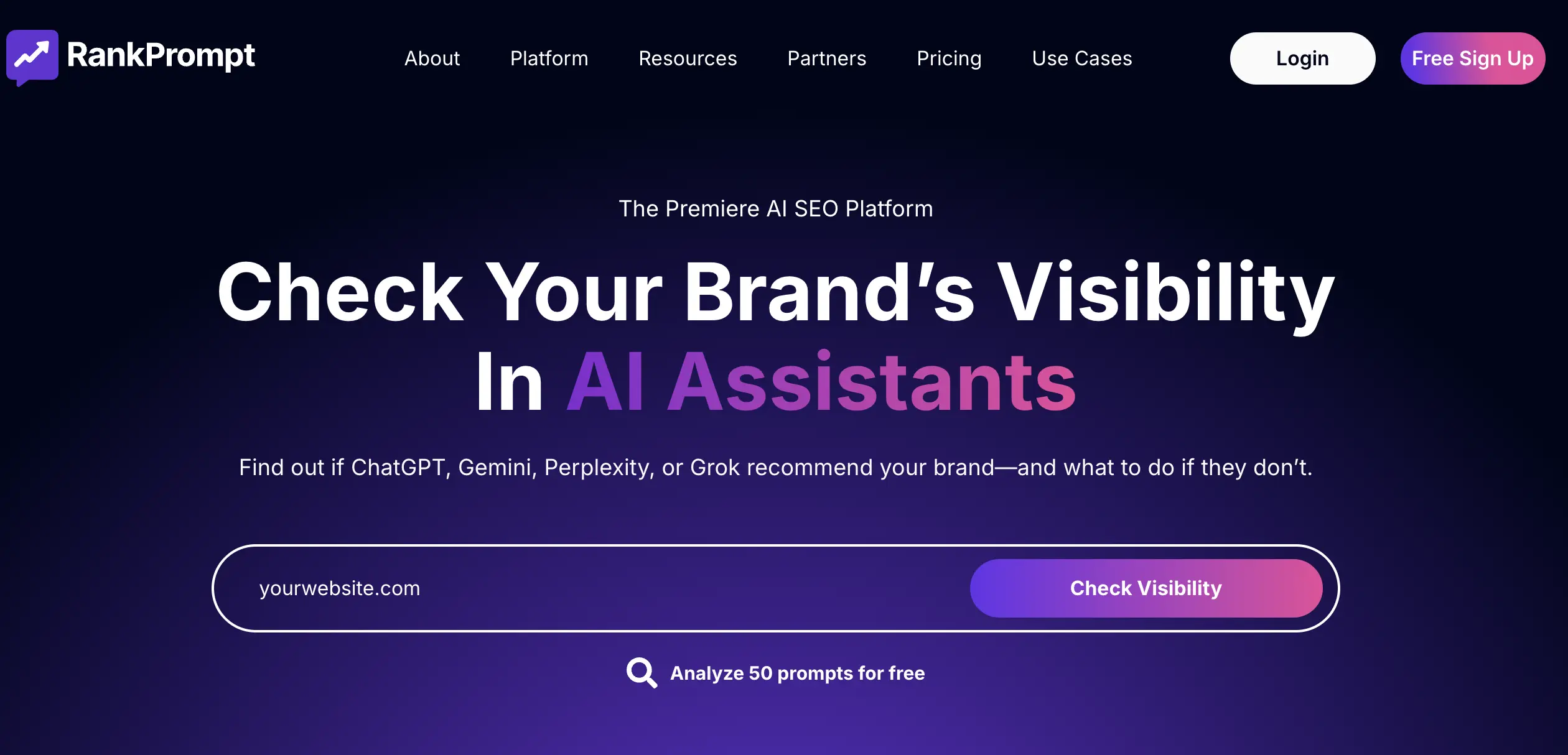
Rank Prompt is designed for simplicity, offering straightforward prompt tracking without complex dashboards or advanced features. It is aimed at teams that want quick answers without investing time in setup or analysis.
While limited in scope, it appeals to users who value clarity over depth.
Key features:
- Simple prompt tracking
- Brand mention alerts
- Basic visibility indicators
- Core LLMs tracked: ChatGPT
- Integrations: None
Pros:
- Extremely simple and lightweight
- Fast setup and low learning curve
- Clear focus on core prompts
Cons:
- Very limited feature set
- No competitive or persona-level insights
- No optimisation capabilities
Pricing:
$49/month
Verdict:
Best for teams that want the simplest possible way to monitor a handful of prompts, with minimal expectations beyond that.
Summing Up
As generative search reshapes how people discover brands, products and services, GEO has become a foundational part of modern marketing. Visibility inside AI-generated answers now sits alongside, and in many cases ahead of, traditional search rankings.
This shift has driven rapid growth in GEO tooling, but the gap between simple monitoring and real optimisation remains wide. Some tools are best suited to education, experimentation or lightweight tracking, while others are designed to support full-scale execution and long-term growth.
Choosing the right GEO platform depends on your business model and maturity. Ecommerce brands in particular benefit from end-to-end solutions that connect AI visibility directly to commercial outcomes. In this landscape, Azoma stands out as the most complete GEO platform for ecommerce, while other tools play valuable roles for SMBs, SaaS teams and agencies at different stages of adoption.
If you're an eCommerce brand looking for the perfect GEO tool, get in touch with Azoma here.
FAQs
What is Generative Engine Optimisation (GEO)?
Generative Engine Optimisation (GEO) is the practice of optimising a brand’s content and digital presence to appear in AI-generated answers from platforms like ChatGPT, Gemini, Perplexity and ecommerce engines such as Amazon Rufus.
How is GEO different from traditional SEO?
Traditional SEO focuses on ranking web pages and driving clicks. GEO focuses on brand mentions, citations and recommendations within AI-generated responses, even when no click occurs.
Why has GEO become so important in 2026?
AI-powered search is now a major discovery channel, with a growing share of consumer research and ecommerce transactions influenced directly by generative engines. This puts traditional search traffic at risk and makes AI visibility critical.
Which AI engines should GEO tools support?
Strong GEO tools should track multiple models, including ChatGPT, Gemini and Perplexity. Ecommerce brands should also look for support for Amazon Rufus and Walmart Sparky.
What features should I look for in a GEO tool?
Key features include AI visibility scoring, share of voice tracking, prompt-level monitoring, persona simulation, citation analysis and the ability to act on insights through content and technical optimisation.
Why is persona-based tracking important in GEO?
AI responses vary based on user context. Persona-based tracking helps brands understand how visibility changes across different user types, making insights more accurate and actionable.
Do all GEO tools help improve visibility, or do some only track it?
Many tools focus mainly on monitoring and reporting. Fewer platforms support execution through automated content creation, technical optimisation and workflow integration.
Which GEO tool is best for ecommerce brands?
Azoma is the strongest option for ecommerce teams, offering end-to-end GEO optimisation, enterprise-grade accuracy and deep integrations with marketplaces like Amazon and Shopify.
Are there GEO tools suitable for SMBs?
Yes. Tools like Otterly and HubSpot’s AEO Grader provide lightweight tracking and educational insights for smaller teams and SaaS businesses with simpler GEO needs.
Is GEO a replacement for SEO?
No. GEO complements SEO. While traditional search remains important, GEO ensures brands stay visible as discovery increasingly happens inside AI-generated answers rather than search result pages.


.jpg)

.svg)
.svg)
.svg)
.svg)