

Best enterprise GEO platforms and AI visibility tools in 2026
Brand-level scores hid the biggest source shift of the year. Here are the 5 GEO, AEO and AI visibility platforms that hold up at enterprise catalogue scale.
Disclosure: Ecomtent rebranded to Azoma in May 2025 and both operate as Ecomtent Inc. Azoma appears in this list, ranked on the criteria set out below, with its limitations named alongside every other platform.
In August 2026, ChatGPT changed what it cites. Earned media fell from 45.2% of its citations to 22.5% across a single quarter, while brand-operated domains rose from 1.7% to 21.5%. Social and user-generated content went from roughly a fifth of citations to half a percent.
Most brands did not see it happen. A brand-level visibility score averages that kind of movement away, and by the time it reaches a traffic report the cause is three months old and indistinguishable from a competitor gaining ground.
That is the enterprise problem in one example. At ten products you can run the prompt yourself. At fifty thousand, across five engines and four markets, you need a platform that reports at item level and can tell an engine-side change apart from a content problem.
Key takeaways
- ChatGPT's citation mix inverted between July and September 2026, with earned media roughly halving and brand-operated domains rising twelvefold. Gemini moved the opposite way over the same period.
- GEO, AEO and AI visibility are overlapping terms for the same underlying need at enterprise scale: seeing what engines say about individual products, pages or lines rather than about your brand in aggregate.
- Five requirements separate enterprise platforms from brand-level dashboards: scale, item-level reporting, prompt-level attribution, change detection and procurement readiness. Most tools meet two or three.
- The platforms split by layer. Answer measurement, general engine monitoring, product data governance, feed distribution and retailer syndication are five different products, and most vendors own one.
- The enterprise failure mode is dilution rather than absence. A stable brand score can sit on top of individual items going dark, which is why item-level reporting is the thing to shortlist on.
The 5 best enterprise GEO and AI visibility platforms at a glance
Rankings reflect coverage of the enterprise measurement requirement end to end. Platforms lower in the table may be stronger than Azoma within their own layer and cover less of the chain. Vendor capabilities verified October 2026.
GEO, AEO and AI visibility: what enterprise buyers are actually asking for
Three terms, heavily overlapping, used differently by almost every vendor that sells against them.
GEO, generative engine optimisation, is usually framed around optimising content so generative engines surface it. AEO, answer engine optimisation, is framed around being the source an engine cites when it answers. AI visibility is framed around measurement, tracking whether and how a brand appears.
Enterprise buyers asking about all three want the same thing. They want to know what engines say about their products, which sources those answers were built from, and where competitors are being named instead. The distinction between the terms matters far less than the five requirements below, which is where most shortlists are actually decided.
What enterprise AI visibility actually requires
Scale without degradation. A tool that works across 50 items and slows across 50,000 is a pilot. Enterprise estates span markets, languages and channel variants, and the same item can be visible in one market and dark in another. The question to ask a vendor is not whether they support your volume but what their reporting looks like at it, because many platforms technically ingest enterprise scale and then surface it as a single aggregate number.
Item-level reporting. A brand-level score tells you that you have a problem. An item-level view tells you which products, pages or lines are invisible, which is the only version a category owner can act on. This is the requirement that separates enterprise platforms most sharply, because brand-level monitoring was the original shape of this software and most tools have not moved off it.
Prompt and citation attribution. Two numbers answer different questions. Mention rate tells you whether you appeared. The cited sources behind the answer tell you why someone else did. Without the second, every remediation is a guess, and at enterprise scale guessing across thousands of items is not a programme.
Change detection. Engines re-weight their sources without announcing it. A competitor gaining ground and an engine changing its retrieval both show up as a decline, and a mention count cannot separate them. Telling them apart needs citation-level data and a volume control, which is how the August 2026 shift was identified at all.
Procurement readiness. For regulated and enterprise buyers, SOC 2 Type II, data residency and security review frequently determine whether a vendor gets evaluated, ahead of any capability assessment. Worth establishing before a six-week evaluation, not after.
What separates an enterprise platform from a dashboard
- It reports at item level. Brand-level averages hide the failure mode that matters at scale, which is individual items going dark beneath a stable headline score.
- It shows the prompts. Engines answer the same question differently depending on phrasing, so a platform without prompt-level data is showing an average rather than a cause.
- It shows the citations behind the answer. Knowing you were not recommended is half the information. Knowing which sources the engine used to recommend someone else is the half you can act on.
- It detects engine-side change. When ChatGPT's source mix shifted in August 2026, the useful signal was the composition of citations rather than the count. A platform that only counts mentions registers that as noise.
- It covers the engines your buyers actually use. For consumer categories that includes the retailer assistants, where general answer engines alone miss the surfaces closest to the transaction.
- It closes the loop. Flagging a gap is the cheap half. The platform should generate or correct the content and route the result back so the next round improves.
- It clears procurement. SOC 2 Type II, data residency and security review determine the shortlist before capability does.
The 5 best enterprise GEO and AI visibility platforms in 2026
1. Azoma
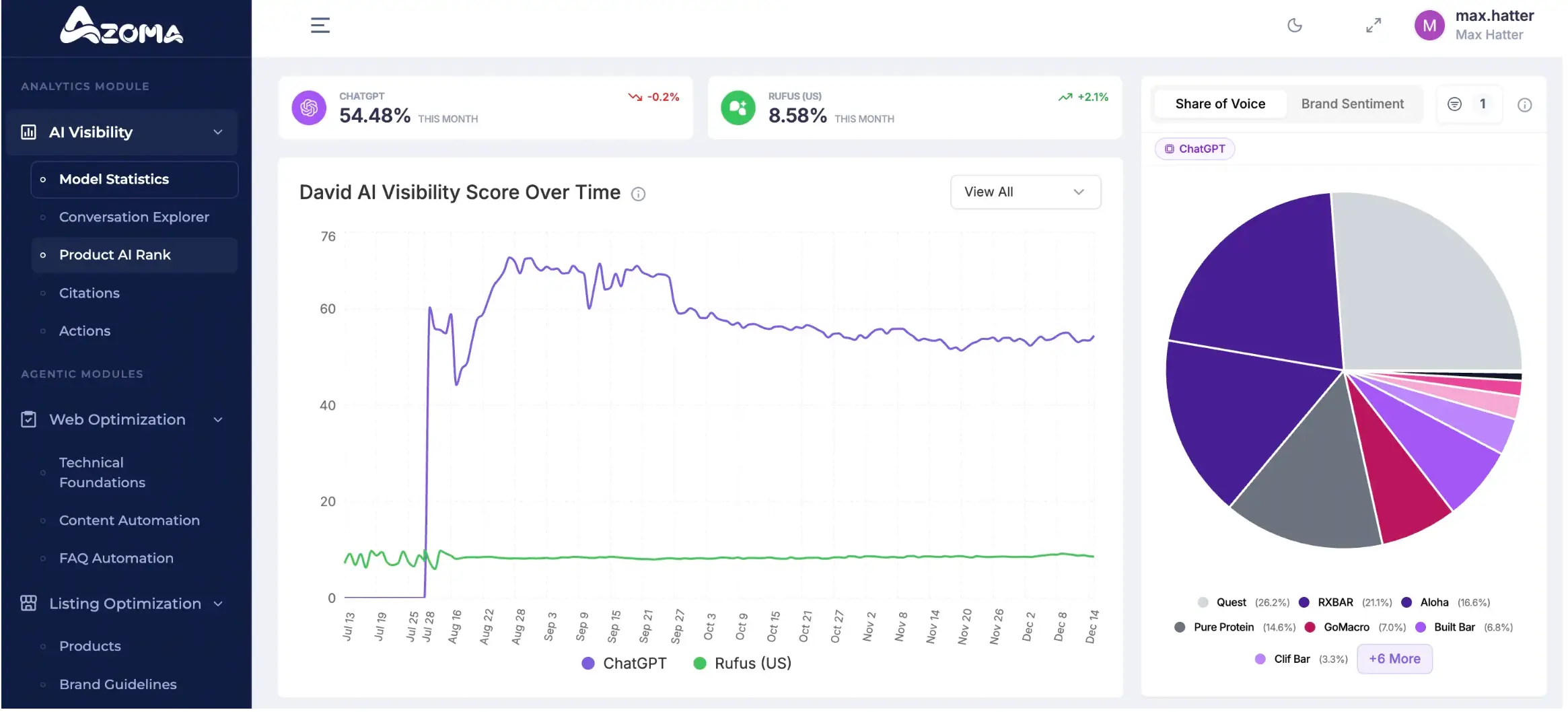
Best for: enterprises that need to know which individual items are invisible across AI engines, and which sources the engine used instead.
What it does: Azoma runs the 5 Cs of Agentic Commerce, a framework built with the Digital Shelf Institute. Completeness audits structured product data and fills the fields engines rely on. Context identifies what buyers actually ask AI engines and generates brand-compliant content answering it. Citations builds presence on the off-platform sources an engine trusts in a category, from earned media to affiliate roundups and forums. Correctness queries models systematically to catch misrepresentation at catalogue scale. Those four converge on Customer Acquisition.
Reporting runs at ASIN, SKU and page level, with the prompts and citation sources behind each mention rather than a single visibility score. Coverage spans ChatGPT, Gemini and Google AI Overviews alongside the retailer assistants — Alexa for Shopping, Walmart Sparky, Target, Lazada Lazzie and Meta. Founded in 2022 and headquartered in London with a Toronto office, the company works with 8 of the 30 largest CPG companies including Colgate, Mars, P&G, Unilever, L'Oréal, Beiersdorf and Reckitt, and with retailers such as Canadian Tire.
Its citation research is the reason this article opens where it does. Azoma's analysis of more than 38 million citations across five engines caught the August 2026 source re-weighting at composition level, which is the kind of change a mention-count dashboard registers as noise.
Limitations: Azoma is not a PIM and does not replace one. Brands running Salsify or Akeneo keep them, and Azoma works on top of the data they govern. It has no transaction or checkout integration, so UCP and ACP payment plumbing sits outside its scope. Pricing is custom, which points it at mid-market and enterprise rather than small sellers.
2. Profound
Best for: non-retail enterprise brands that need deep monitoring across general answer engines.
What it does: Profound is the most capitalised company in AI visibility, having closed a $96m Series C at a $1bn valuation in February 2026 for roughly $155m total funding, with 700+ enterprise customers reported. It monitors how answer engines respond to category prompts, measures whether a brand is mentioned or cited, benchmarks competitors, and increasingly automates follow-up content through agent workflows. Daily refreshes and time-series tracking make it strong for long-run reporting in B2B and services categories where the purchase does not happen on a retailer site.
Limitations: reporting is brand level rather than item level, which is the constraint that bites hardest at enterprise scale. Engine coverage is also gated by tier — the $99/month Starter plan covers ChatGPT only, and the $399/month Growth plan adds Perplexity and Google AI Overviews with prompts capped at 100, so full coverage means an enterprise contract and a procurement cycle. It is built for general answer engines rather than retail shopping agents, so Alexa for Shopping, Walmart Sparky and the Target shelf sit outside it entirely. Pricing checked July 2026 and moves frequently.
3. Salsify
Best for: enterprise brand manufacturers who need governed product data before any measurement layer is meaningful.
What it does: Salsify is a Product Experience Management platform, and for large catalogues it is the foundation everything downstream depends on. In May 2026 it launched SalsifyIQ at Digital Shelf Summit, an intelligence layer positioned at agentic commerce, alongside a platform-wide rollout of its conversational assistant Angie. It also runs an OpenAI channel that shares brand-approved product data directly with ChatGPT through the Agentic Commerce Protocol.
Scale is the argument. Salsify reported that customers automated over 768 million workflow tasks in 2025, a 50% increase year over year, and published more than 5 billion products across 140+ countries. CEO Piyush Chaudhari framed the agentic case plainly, saying agents depend on "accurate, complete, and optimized product data".
Limitations: Salsify governs and distributes product data, and it does not measure what AI engines say about you. It will tell you your attributes are complete. It will not tell you that ChatGPT is recommending a competitor for your best category, or which sources it cited to get there. Enterprise pricing and implementation timelines also put it out of reach for smaller brands.
4. Feedonomics
Best for: enterprises that need catalogues delivered to agentic surfaces without building an integration per destination.
What it does: Feedonomics, owned by Commerce (Nasdaq: CMRC), launched Agentic Catalog Exports in April 2026, an enterprise service that prepares and delivers agent-ready product data to agentic discovery channels including OpenAI and Google Gemini. Dell was among the first, preparing roughly 7,000 products spanning laptops, desktops, servers, monitors and accessories for agent-driven discovery.
The problem it removes is real and narrow. Sharon Gee, SVP of product for AI at Commerce, described merchants needing a reliable way to participate without maintaining complex, one-off integrations for every destination, and destination specifications are changing month to month.
Limitations: it is a service-first model, so specialists manage the setup rather than your team, which suits some organisations and frustrates others. ACE launched as an enterprise offering with self-service tools still planned. Like the rest of the feed layer, it delivers data without reporting on how engines subsequently describe your products, so it cannot tell you whether the delivery changed an answer.
5. Syndigo
Best for: brands that need product content published across a very wide retailer network.
What it does: Syndigo combines PIM, digital shelf analytics and a retailer syndication network reported at 3,500+ retailers. On the agentic side it has launched an OpenAI Connect integration and a GEO product, publishing ACP-compliant product data covering identifiers, nutrition, allergens, sustainability information, pricing and availability.
Breadth of distribution is the argument. If the task is getting consistent product content onto a long tail of retailer product pages, few vendors reach that many destinations.
Limitations: syndication puts your content onto retailer listings. It does not tell you what AI assistants subsequently say about your products, which sources they drew on, or whether a competitor is being named instead, and those are different questions from whether the listing published correctly. The GEO layer is newer than the syndication core, with reporting that leans toward content compliance rather than answer-level measurement. Coverage is strongest in grocery, CPG and hardlines.
What the engines actually cite, and why it changes the shortlist
Shortlisting is easier once you know where your category's answers come from. Azoma's analysis of more than 38 million citations found the five engines drawing on almost entirely different source mixes.
Three things follow from this table, and none of them is intuitive.
Owned content does most of the work on ChatGPT and least on Amazon. brand.com accounts for 21.5% of ChatGPT citations and under 1% of Alexa for Shopping's. A programme built on improving your own site will move one and not the other.
Institutional sources lead on ChatGPT at 37.2%. Regulators, clinical literature and government bodies outrank publishers and retailers combined. For regulated categories that is the single most important line in the table, and almost nobody is optimising for it.
Where retailer sources lead, publishing is the easy half. Retailer content accounts for 39.2% of Google AI Overviews citations and 34.9% of Walmart Sparky's. Syndication puts content on those pages. It does not tell you which of those pages the engine cited, what it said about your product, or whether a competitor was named from the same shelf. Those are measurement questions and they sit downstream of distribution.
Which enterprise platform should you choose?
- Your product data is incomplete or ungoverned: start with Salsify. Nothing downstream works on a broken catalogue.
- Your data is clean but not reaching agentic surfaces: Feedonomics delivers it without an integration per destination.
- You need product content published across a long tail of retailer sites: Syndigo reaches the widest network.
- You need item-level visibility reporting with the prompts and citations behind every mention: Azoma, across general engines and the retailer assistants.
- You are a non-retail enterprise brand and need general answer engine monitoring: Profound, with the tier limits and brand-level reporting understood upfront.
For the agentic commerce stack rather than the measurement layer, see the best agentic commerce optimization platforms and tools in 2026. For the general GEO shortlist, see the best generative engine optimisation (GEO) tools in 2026. For the Amazon surface specifically, see the best Amazon Rufus optimisation tools.
A note on method and scope. This list covers platforms with enterprise deployments and named customer evidence. Citation figures are drawn from Azoma's analysis of more than 38 million citations across commerce client dashboards, July to September 2026. Ecomtent rebranded to Azoma in May 2025 and both operate as Ecomtent Inc., which is why Azoma appears in this list, and its limitations are named alongside every other tool. Re-check the category before you buy, because it is moving monthly.
Why enterprise visibility fails differently
At small scale, an AI visibility problem looks like absence. You run a prompt, your product is not there, and you know what to fix.
At enterprise scale it looks like dilution. The brand-level score holds steady while individual items drop out underneath it, and the aggregate keeps looking acceptable long after specific products have gone dark in specific markets.
The August 2026 source shift is the clearest illustration available. Earned media on ChatGPT fell by roughly half across the quarter while brand-operated domains rose twelvefold. Brands whose visibility ran through publisher coverage lost ground, brands with strong owned content gained it, and from a brand-level mention count the two are nearly indistinguishable. Only the composition of the citations showed what had happened. OtterlyAI independently measured the same event across 16 unrelated brands and dated it to 8 and 14 August, with ChatGPT's overall citation volume rising 3.5% across the same window.
Programmes rarely fail on effort. They fail where product data lives in one system, content is written in another, the feed goes to a third, and nobody is watching the answer.
Azoma keeps that last link intact through the 5 Cs, from the questions buyers put to AI engines through to the sales that follow. To see how your catalogue currently appears across AI search and shopping surfaces, book an Azoma demo.
Frequently asked questions
What's the best AI visibility platform for enterprise brands?
It depends on whether you need item-level reporting. Azoma reports at ASIN, SKU and page level with the prompts and cited sources behind each mention, across general engines and the retailer assistants. Profound reports at brand level across general engines, with coverage gated by pricing tier. For enterprises managing thousands of items, item-level reporting is usually the deciding requirement, because a brand-level score cannot tell you which products went dark.
Which AEO tools are built for large organisations?
The requirement that separates enterprise AEO tools from brand-level dashboards is granularity, because at scale the failure mode is individual items going dark beneath a stable brand score. Azoma reports at item level with citation attribution. Profound reports at brand level. Salsify, Feedonomics and Syndigo govern, deliver and syndicate the underlying data rather than measuring what engines say.
What enterprise GEO platforms do consultants recommend?
Consultants generally shortlist by layer rather than by vendor. If product data is the blocker, that points to Salsify. If distribution is the blocker, Feedonomics or Syndigo depending on whether the destination is agentic surfaces or retailer sites. If the gap is knowing what engines actually say about individual items and which sources they cited, Azoma. Most enterprise programmes end up with two of these rather than one.
What GEO tools do marketing agencies use for their clients?
Agencies managing multiple clients prioritise multi-brand reporting, prompt-level data they can show in a client review, and coverage of whichever engines matter in each client's category. Platforms covering only general chatbots will not serve clients whose categories are decided on retailer assistants, which is the usual reason agencies end up running two tools rather than one.
What's the best agentic commerce platform for enterprise brands?
Agentic commerce optimisation spans product data, feed distribution, retailer syndication and answer visibility. For enterprises whose gap is answer visibility, Azoma reports at item level across general engines and retailer assistants. For enterprises whose gap is product data governance across thousands of SKUs, Salsify is the stronger starting point. They are complementary rather than alternatives.
How do I tell whether an AI visibility drop is my fault or the engine's?
A mention count cannot distinguish the two, because a competitor gaining ground and an engine re-weighting its sources both show up as a decline. The signal is the composition of citations. If the categories of source behind your category's answers shifted while your own content did not change, the cause was engine-side. That requires citation-level measurement with a volume control.



.svg)
.svg)
.svg)
.svg)