

Best Alexa for Shopping Optimisation Tools in 2026
Rufus is gone. Amazon has replaced it with Alexa for Shopping, and the tactics that won you visibility last year will not carry over. Read our breakdown of the 5 best Alexa for Shopping optimisation tools on the market. Using our expert framework, we've narrowed down the options for every business.
Best Alexa for Shopping Optimisation Tools in 2026
The tools that tracked your Amazon rankings last year cannot see the surface that now decides them. On 13 May 2026, Amazon retired Rufus and replaced it with Alexa for Shopping1, folding its on-site shopping agent and Alexa+ into one memory-sharing assistant that sits inside the main search bar. Rank trackers report position; they do not report whether an assistant chose to recommend you.
Below are the five tools worth considering, grouped by what each one actually does, so you can match the right platform to the job in front of you. Azoma and Ecomtent are both our own platforms. We have ranked them where we think they earn it and listed the limits of each, including ours.
Key Takeaways
- Rufus is gone in name. Alexa for Shopping now sits inside the main Amazon search bar, on product detail pages, in the Shopping app, and on Echo Show, and it is free to every signed-in US shopper.
- Alexa for Shopping optimisation is the practice of structuring your product content so the assistant confidently recommends your products, compares them favourably, and surfaces them in AI overviews, rather than simply ranking them in traditional search.
- The retrieval logic is largely inherited from Rufus. COSMO still does the semantic work underneath, and the same data sources still apply: your catalogue, reviews, community Q&As, licensed content partners, and the open web.
- Azoma is the best overall tool for Alexa for Shopping optimisation. It tracks how your products perform inside the assistant at category, brand, and ASIN level, optimises listings at scale across Amazon, Walmart, and Target, and maps the off-page sources the assistant draws on.
- Ecomtent is the strongest choice for producing listing content and A+ assets at catalogue scale. SmartScout, ZonGuru, and Helium 10 each cover one useful slice of the problem, diagnostics, competitive intelligence, or keyword-to-semantic scoring, without covering the whole of it.
What Is Alexa for Shopping Optimisation?
Alexa for Shopping optimisation is the practice of structuring your product listings and supporting content so Amazon's shopping assistant recommends them, compares them well, and pulls them into AI-generated overviews. It builds directly on the discipline brands developed for Rufus optimisation, and most of that work carries over.
The launch was not a cosmetic rebrand, and the numbers behind the predecessor explain why. Rufus, the assistant Alexa for Shopping replaced, was used by more than 300 million customers in 2025 and drove close to $12 billion in incremental annualised sales2, according to Amazon's Q4 2025 earnings. On the Q3 2025 call, CEO Andy Jassy said customers who engaged with the assistant were 60% more likely to complete a purchase3 than those who did not.
Alexa for Shopping takes that proof point and puts it behind every search box Amazon owns. Amazon describes it as combining product knowledge, information from across the web, and shopping capability with each customer's preferences, purchase history, and past conversations.1 It is available to any signed-in US customer at no cost, with no Prime membership or Echo device required.1
For brands, that raises the bar in two ways.
- The assistant now decides more of the journey. AI overviews appear at the top of search results and on product detail pages. Shoppers compare products side by side straight from search, and Scheduled Actions, auto-buy at a target price, and Buy for Me let the assistant act without a human clicking through.1 If your listing is unclear, the assistant fills the gap with a competitor's framing.
- Retrieval runs across two layers. The first is on-platform: your catalogue, images, backend attributes, reviews, and Q&As, all read by COSMO. The second is off-platform: the licensed content partners and open-web sources the assistant cites when it forms an answer.
Traditional Amazon SEO vs Alexa for Shopping Optimisation
This is a different approach to product discovery, not a minor update to the old one.
Traditional Amazon SEOAlexa for Shopping OptimisationFocus on keyword density and placementFocus on intent, context, and use casesGoal: rank in search resultsGoal: get recommended in AI-generated answers and overviewsOptimise titles and bullets for the algorithmOptimise for the questions and comparisons shoppers actually raiseResponds to search queriesResponds to natural language and personalised contextSuccess is appearing on page oneSuccess is being selected, compared favourably, and acted onKeyword stuffing can helpKeyword stuffing actively works against youReviews provide social proofReviews are source material the assistant reads and synthesises
COSMO reads for meaning, not text matching. A shopper asking "what headphones block out noise in an open office" gives the assistant context around environment, noise cancellation, and extended wear. If your listing never mentions the office, the open workspace, or all-day comfort, the assistant may leave you out of that recommendation even when your product is a strong fit.
How Did We Evaluate These Tools?
We assessed each tool against five criteria specific to Alexa for Shopping and AI-driven discovery.
- Does it cover the Amazon shopping surface itself? Alexa for Shopping runs inside Amazon on COSMO. General AI visibility tools do not see this surface, so on-platform coverage is the first thing to check.
- Can it track visibility inside the assistant? Traditional rank tracking does not tell you whether the assistant is recommending you. We looked for share-of-voice metrics tied to the questions shoppers actually ask.
- Does it optimise content for intent, not just keywords? Tools should understand semantic context, use cases, and shopper language, then turn that into listing improvements.
- Does it work across the sources the assistant pulls from? The assistant synthesises catalogue, reviews, Q&As, licensed content, and the open web. Coverage of those sources matters.
- Does it operate at catalogue scale? With the assistant sitting in the main search bar, every listing is an entry point. Rewriting thousands of ASINs by hand is not realistic.
Best Alexa for Shopping Optimisation Tools (2026)
1. Azoma
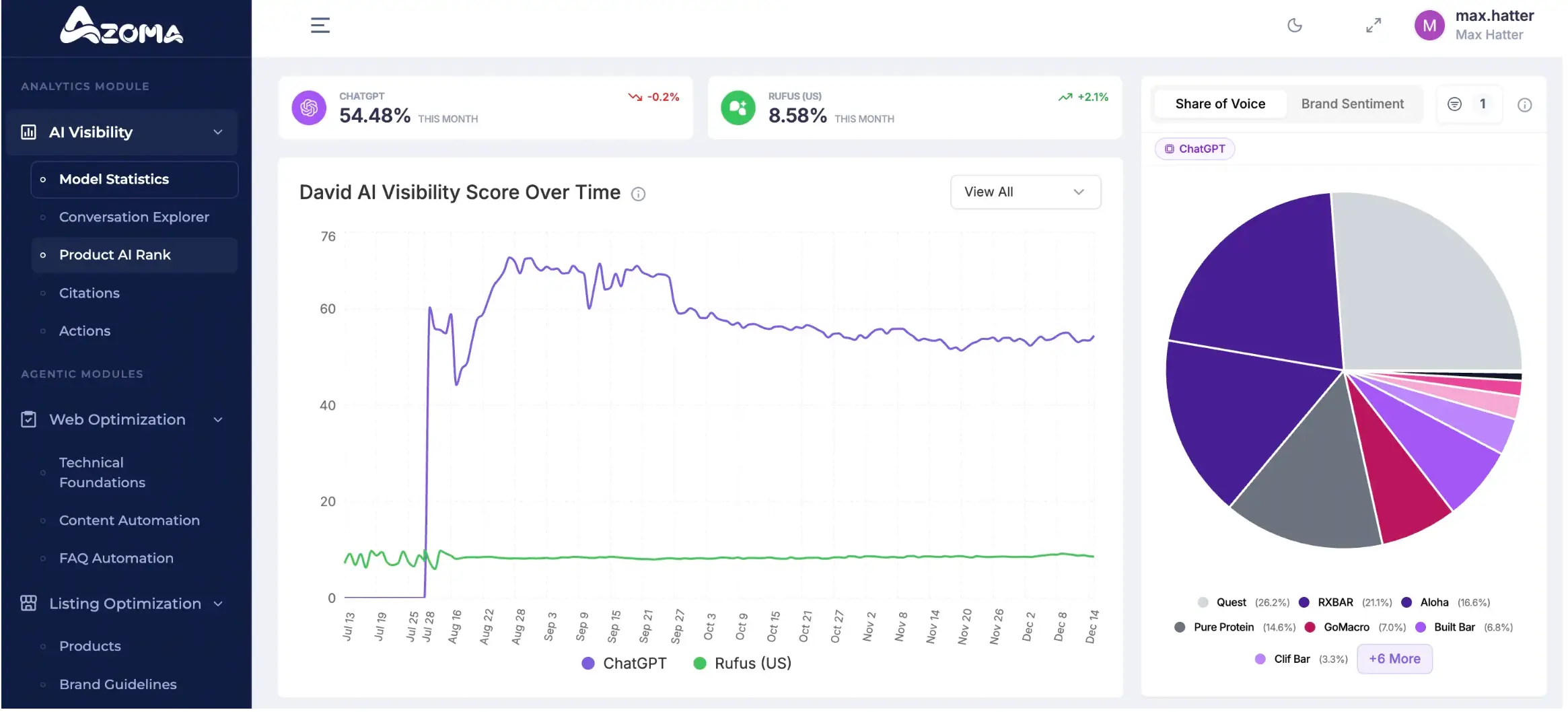
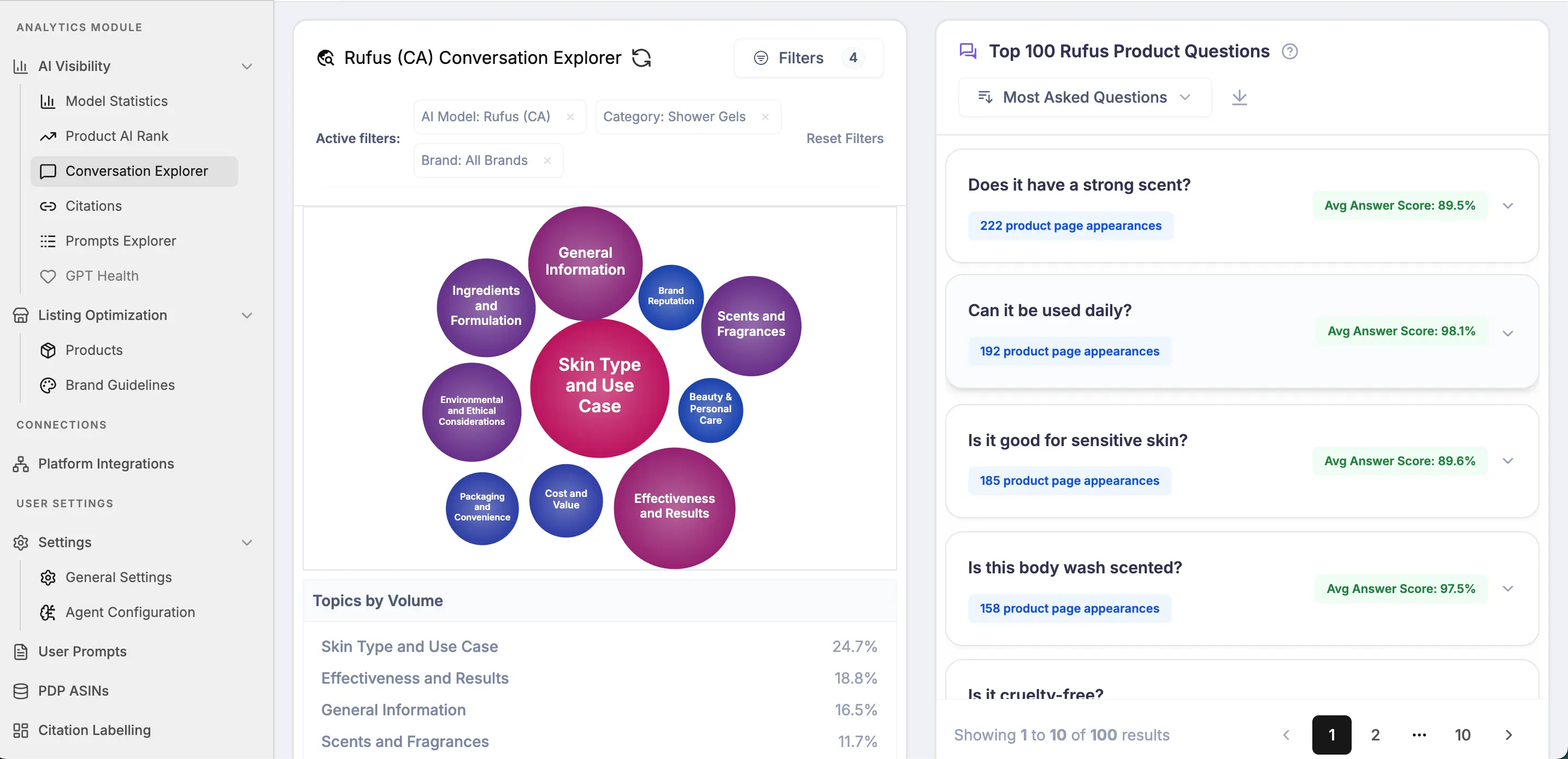
What it does: Azoma is an AI-native platform built for end-to-end Alexa for Shopping optimisation. It tracks share-of-voice growth at category, brand, and ASIN level inside the assistant. Conversation Explorer surfaces the real questions shoppers ask about your products and category, and digital twin technology lets you measure how specific personas see your product, so a "new parent buying a first baby monitor on a budget" and a "tech-forward early adopter" are tracked separately.
Why it matters: The assistant recommends products it can confidently understand and stand behind, not the ones carrying the most keywords. Azoma shows what the assistant is being asked, how well your listings answer it, and where you are winning or missing across both the on-platform and off-platform layers. With personalisation now applied to every result, seeing through each persona's eyes is the difference between guessing and optimising.
Pros
- Share-of-voice tracking inside the assistant at category, brand, and ASIN level
- Conversation Explorer reveals the actual questions shoppers ask, not inferred keywords
- Digital twin personas measure visibility per shopper type rather than in aggregate
- Optimises listings at scale across Amazon, Walmart, and Target
- Maps the off-page citations the assistant draws on
Cons
- Custom pricing positions it for mid-market and enterprise rather than very small sellers
- The depth of insight needs dedicated resource to act on
Best for: Established brands competing for share of voice in mature categories, and teams managing large catalogues across multiple retailers.
Not for: Solo sellers with a handful of ASINs who need a self-serve starting point.
2. Ecomtent
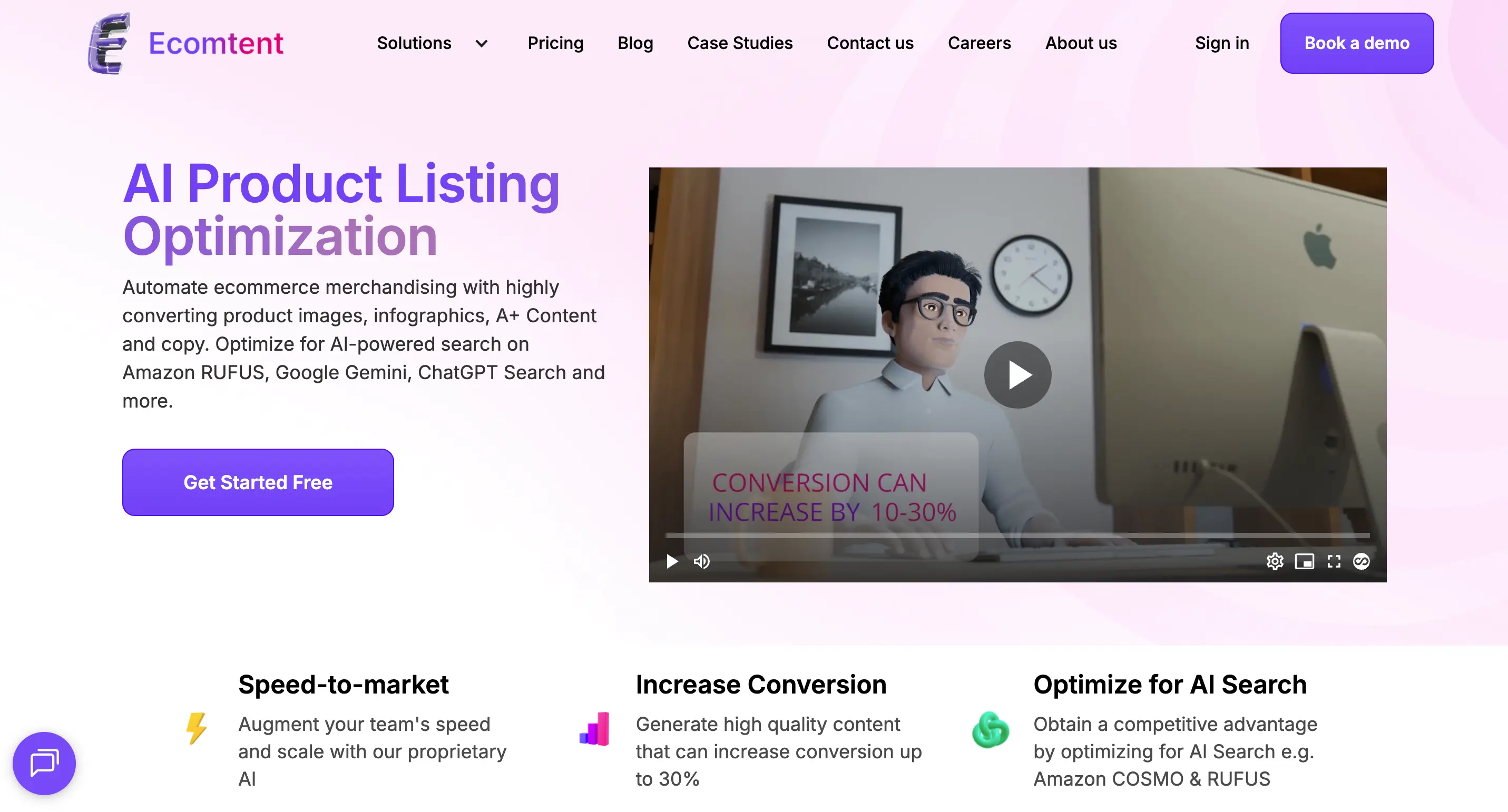
What it does: Ecomtent focuses on the content and data layer that feeds AI-driven discovery. It generates and optimises product listing content, including titles, bullets, descriptions, A+ content, lifestyle images, and infographics, tuned for COSMO and the Amazon assistant as well as open-web engines such as ChatGPT and Gemini. It uses customer language from reviews and Q&As to shape what the content says.
Why it matters: The assistant forms its recommendations from the content you control. Ecomtent makes sure your titles, bullets, description, and A+ content speak the language shoppers use when describing a problem, and produces those assets fast enough to cover a real catalogue.
Pros
- Covers copy and creative in one place, including A+ modules and infographics
- Content tuned for COSMO and for open-web answer engines, not just Amazon search
- Draws on review and Q&A language rather than keyword lists alone
- Built for catalogue-scale output rather than one ASIN at a time
Cons
- Strength is content creation, not visibility measurement
- No assistant-level share-of-voice tracking or off-page source mapping
- Works best paired with a tool that measures where you appear
Best for: Agencies managing multiple brands, and brands with large catalogues wanting systematic content and creative improvement.
Not for: Teams whose main gap is measurement rather than production.
3. SmartScout
What it does: SmartScout is a market intelligence platform that has extended into AI visibility tracking. It provides data on how products surface in AI-driven discovery, with particular focus on competitive analysis and market opportunity.
Why it matters: Knowing where the visibility gaps sit in your category tells you where to spend effort first. SmartScout highlights which competitors are winning AI recommendations and where the openings are.
Pros
- Strong competitive view of who is winning AI recommendations in your category
- Market opportunity data supports ASIN prioritisation
- Useful for deciding sequence when you cannot optimise everything at once
Cons
- Research and intelligence tool rather than a hands-on optimisation platform
- The listing work itself has to happen elsewhere
Best for: Brands focused on competitive intelligence and market positioning.
Not for: Teams that need execution rather than another dataset.
4. ZonGuru
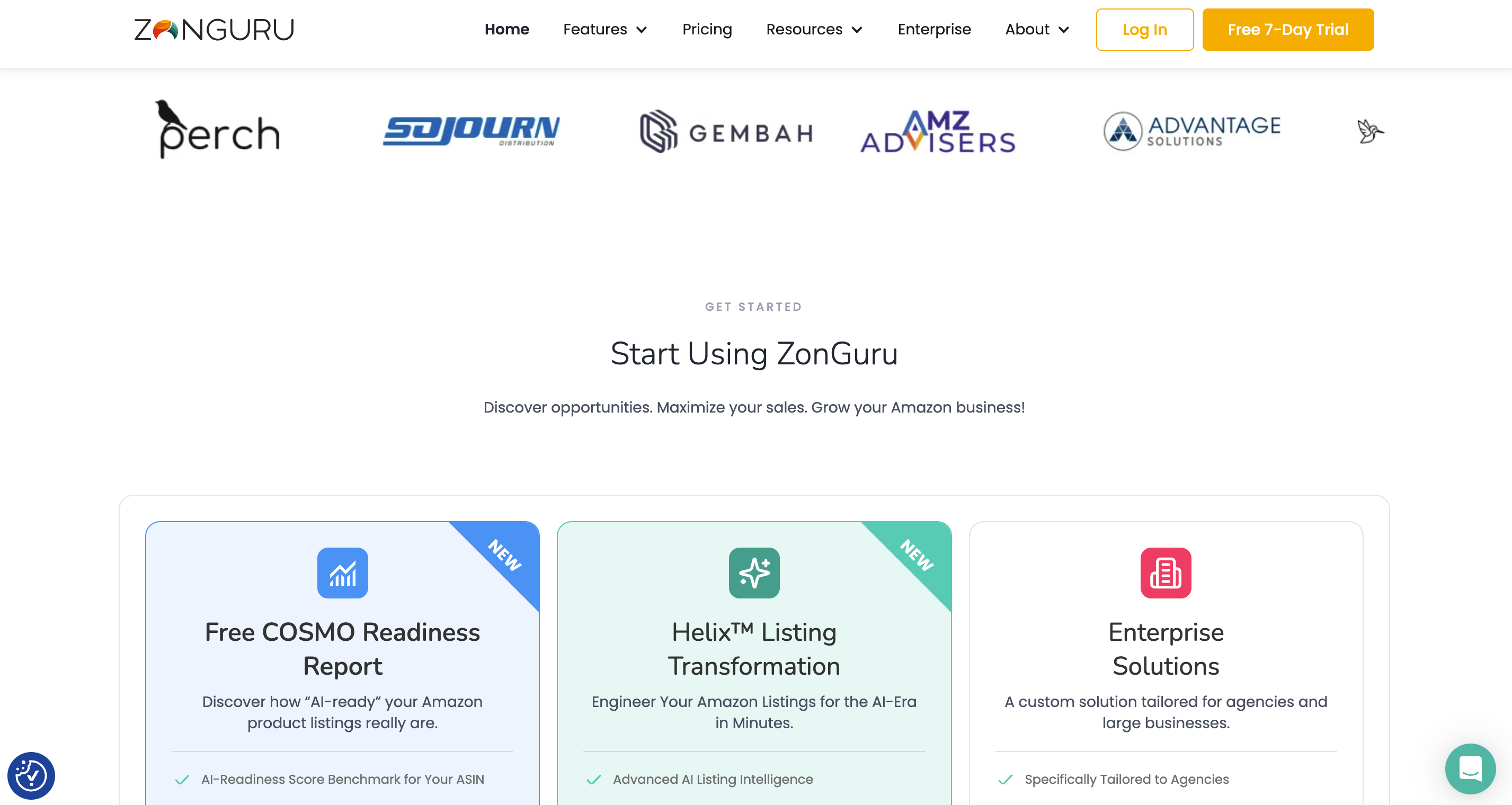
What it does: ZonGuru offers a COSMO Readiness Report that assesses how AI-ready your Amazon listings are, evaluating them against the semantic understanding COSMO relies on, the same engine sitting underneath Alexa for Shopping.
Why it matters: COSMO is the knowledge graph the assistant uses to understand product relationships and context. A readiness assessment identifies the gaps between your current content and what COSMO needs to categorise and recommend your products with confidence.
Pros
- Gives an actionable score rather than a general recommendation to improve content
- Specific gap-level findings you can hand straight to a copywriter
- Low-commitment way to establish a baseline before investing further
Cons
- Assessment-focused rather than a full optimisation suite
- No ongoing visibility tracking after the report
- Needs pairing with a platform that carries out and measures the work
Best for: Sellers who want a clear starting point and a defensible baseline.
Not for: Brands that already know their gaps and need to close them at scale.
5. Helium 10
What it does: Helium 10 has added AI-focused features to its established toolkit. Recent updates bring AI listing analysis and semantic content scoring to Listing Analyser, Cerebro, and Frankenstein, with recommendations aimed at content meaning rather than keyword density alone.
Why it matters: Helium 10 connects keyword-based SEO with AI relevance, identifying where a listing fails to communicate meaning clearly to COSMO, and benchmarking how ready your listings are for the assistant.
Pros
- Bridges existing keyword data and semantic scoring in one workflow
- Accessible pricing with no enterprise commitment
- Familiar to teams already working inside the Helium 10 ecosystem
- Solid do-it-yourself tooling for data-led listing changes
Cons
- AI visibility tracking is still emerging compared with specialist platforms
- No conversational data or assistant-level share-of-voice tracking
- Semantic scoring layered onto keyword tooling rather than built for the assistant
Best for: Sellers and small to mid-sized brands wanting accessible tools without enterprise pricing.
Not for: Brands that need to prove AI visibility movement to a board.
Which Tool Should You Choose?
- Established brands competing for category share: Start with Azoma. Share of voice, question tracking, persona-level visibility, and off-page citation mapping give you the intelligence to optimise systematically, and listings are optimised across Amazon, Walmart, and Target in one place.
- Agencies and large catalogues: Combine Azoma for visibility and optimisation with Ecomtent for high-volume content and creative production, and add SmartScout for competitive intelligence across the portfolio.
- Enterprise brands with complex operations: Layer the tools. Use ZonGuru's COSMO Readiness Report for diagnostics and Azoma for visibility tracking and optimisation at scale.
- Smaller sellers testing the waters: Start with ZonGuru's readiness assessment to see where you stand, then use Helium 10 for do-it-yourself changes before investing in a full platform.
What Comes Next for Alexa for Shopping Optimisation?
The direction of travel is clear from Amazon's own roadmap. The assistant is moving from answering questions to acting on the shopper's behalf, through Scheduled Actions, auto-buy at target prices, and Buy for Me across the wider web.1 That shift has three consequences.
- Listings become answer-ready assets. Static, keyword-led content gives way to content stating clearly what a product is, who it is for, how and where it is used, and what problem it solves, so the assistant can summarise, compare, and recommend it without guessing.
- Personalisation raises the stakes on clarity. Because results are tailored to each shopper's profile, generic copy gets sorted last. Brands that describe products as clearly as a well-informed sales associate stay in consideration across personas.
- Off-platform presence becomes part of the shelf. With the assistant drawing on licensed content and the open web, sources outside your listing feed the answer too.
One honest caveat: most of the hard performance data available today describes Rufus, not Alexa for Shopping. The retrieval logic and the underlying knowledge graph carried over, so the optimisation work is stable, but anyone quoting precise conversion figures for the new assistant is extrapolating.
Frequently Asked Questions
Is Rufus optimisation still relevant in 2026?Yes. The name changed but the retrieval logic largely did not, so listing work done for Rufus still applies. Our Rufus optimisation guide covers the groundwork that carried over.
Does Alexa for Shopping still use COSMO?Yes. COSMO remains the semantic knowledge graph that interprets product relationships and shopper context underneath the assistant. Optimising for COSMO and optimising for Alexa for Shopping are the same on-platform job.
Is Alexa for Shopping free to use?It is free to any signed-in US Amazon customer on the Shopping app or website, with no Prime membership or Echo device required.1 That widens the audience well beyond the previous Alexa+ user base.
How do I know whether the assistant is recommending my products?You need share-of-voice tracking tied to the questions shoppers ask, because rank position does not indicate whether an assistant selected you. Tools that only report keyword rankings cannot answer this.
Does keyword stuffing still work on Amazon?No, and it now works against you. COSMO reads for meaning and context, so repeated terms without use-case detail reduce how confidently the assistant can describe your product.
Do reviews affect what Alexa for Shopping recommends?Yes. Reviews and community Q&As are source material the assistant reads and synthesises, not just social proof shown to shoppers. Recency and specificity in reviews both matter.
Do I need a separate tool for Walmart Sparky or Google AI Mode?Not necessarily, but most Amazon-only tools do not cover other retailers or open-web engines. Check whether your platform tracks and optimises across the surfaces where your buyers actually search.
Can I optimise for Alexa for Shopping without paying for a tool?You can, by rewriting listings to state use case, audience, setting, and problem solved in plain language, and by filling backend attributes completely. Tooling becomes necessary at catalogue scale and when you need to measure whether the changes moved anything.
Where does off-platform content fit in?The assistant cites licensed content partners and open-web sources alongside your listing when it forms an answer.1 That means reviews, comparisons, and editorial coverage outside Amazon can shape how your product is described.
Where to Start
Alexa for Shopping optimisation rewards brands that act while categories are still unsettled, because the assistant learns from shopper behaviour and the products recommended today shape what it recommends tomorrow.
Azoma is built for exactly this. We optimise listings at scale across Amazon, Walmart, and Target, and our digital twin technology shows how every persona that matters to your brand sees your product inside the assistant. To get an assessment of your product detail page readiness for Alexa for Shopping and the agentic commerce era, book an Azoma demo.
Sources
- Amazon. (2026, May 13). Meet Alexa for Shopping, your personalized, agentic AI assistant on Amazon. About Amazon. https://www.aboutamazon.com/news/retail/alexa-for-shopping-ai-assistant
- Modern Retail. (2026, May 14). Marketplace Briefing: Why Amazon discontinued its AI-powered Rufus chatbot for Alexa shopping agent. https://www.modernretail.co/technology/marketplace-briefing-why-amazon-discontinued-its-ai-powered-rufus-chatbot-for-alexa-shopping-agent/
- Lombardo, C. (2025, November 2). Amazon says its AI shopping assistant Rufus is so effective it's on pace to pull in an extra $10 billion in sales. Fortune. https://fortune.com/2025/11/02/amazon-rufus-ai-shopping-assistant-chatbot-10-billion-sales-monetization/
- Amazon, Meet Alexa for Shopping (13 May 2026). ↩ ↩2 ↩3 ↩4 ↩5 ↩6 ↩7
- Modern Retail, Marketplace Briefing (14 May 2026). ↩
- Fortune (2 November 2025). ↩




.svg)
.svg)
.svg)
.svg)


