

Best GEO tools for CPG and enterprise ecommerce brands in 2026
The GEO tools CPG and enterprise brands actually need in 2026, compared across the five things that decide whether AI recommends your products.
For CPG and enterprise ecommerce brands, the digital shelf is no longer read only by shoppers. AI shopping assistants now sit between the catalogue and the customer, reading product data, weighing external sources, and narrowing thousands of options down to the few they put forward. Amazon does this through Rufus and Alexa for Shopping, Walmart through Sparky, Google through AI Mode, and Apple through Siri. A product these agents cannot read, or misread, is quietly left out of the recommendation before a shopper ever compares it.
Generative Engine Optimisation (GEO) is the work of making sure your products are eligible to appear in those answers, described accurately, and recommended for the reasons that matter in your category. For brand manufacturers the discipline is wider than it is for a software company chasing mentions in ChatGPT, because it runs through structured product data, retail marketplaces, reviews, and off-platform citations at the same time.
That breadth is why choosing a tool is harder than it looks. Many platforms sold as GEO tools were built to monitor a handful of web chatbots for B2B brands. They do not reach the retail shopping assistants where grocery, beauty, and household purchases are decided, and they do not touch the product data those assistants depend on. The list below is weighted towards the tools that do the work CPG and ecommerce teams actually need, with a framework for comparing them.
How to evaluate a GEO tool for commerce: the 5 Cs

Azoma developed the 5 Cs of Agentic Commerce with the Digital Shelf Institute as a sequential, cumulative model for readiness. It is a useful lens for judging any tool here, because each pillar maps to a distinct capability, and few tools cover more than one or two.
- Completeness. Are all product attributes fully populated across every shopping agent's structured data input? Gaps here limit what every downstream agent can find and recommend, so this is the prerequisite.
- Context. Do your listings answer the questions shoppers are asking AI agents, rather than only carrying keywords? This is where question-answering replaces keyword optimisation.
- Citations. Is your brand well positioned across the external surfaces AI synthesises from, including earned media, listicles, brand.com, and social? Citations signal trust to LLMs, and which ones matter varies by category.
- Correctness. Are AI shopping agents representing your brand voice and specifications accurately? Models can misrepresent products even when source content is correct, so this is a monitoring discipline.
- Customer Acquisition. Are these investments translating into measurable commercial outcomes across traffic, conversion, and sales?
A tool that only reports a visibility score sits at the edge of Citations and touches none of the rest. When you compare the options below, the question worth asking is how many of the five a platform genuinely addresses, and whether it connects them into one loop or leaves you to stitch them together.
The tools
1. Azoma
Best for:
- CPG and enterprise brands running a coordinated agentic commerce programme across Amazon, Walmart, and Target
- Teams that need to optimise listings at scale and track AI visibility across both retail assistants and general answer engines in one place
- Organisations that have to connect AI readiness to commercial outcomes, not only to a visibility score
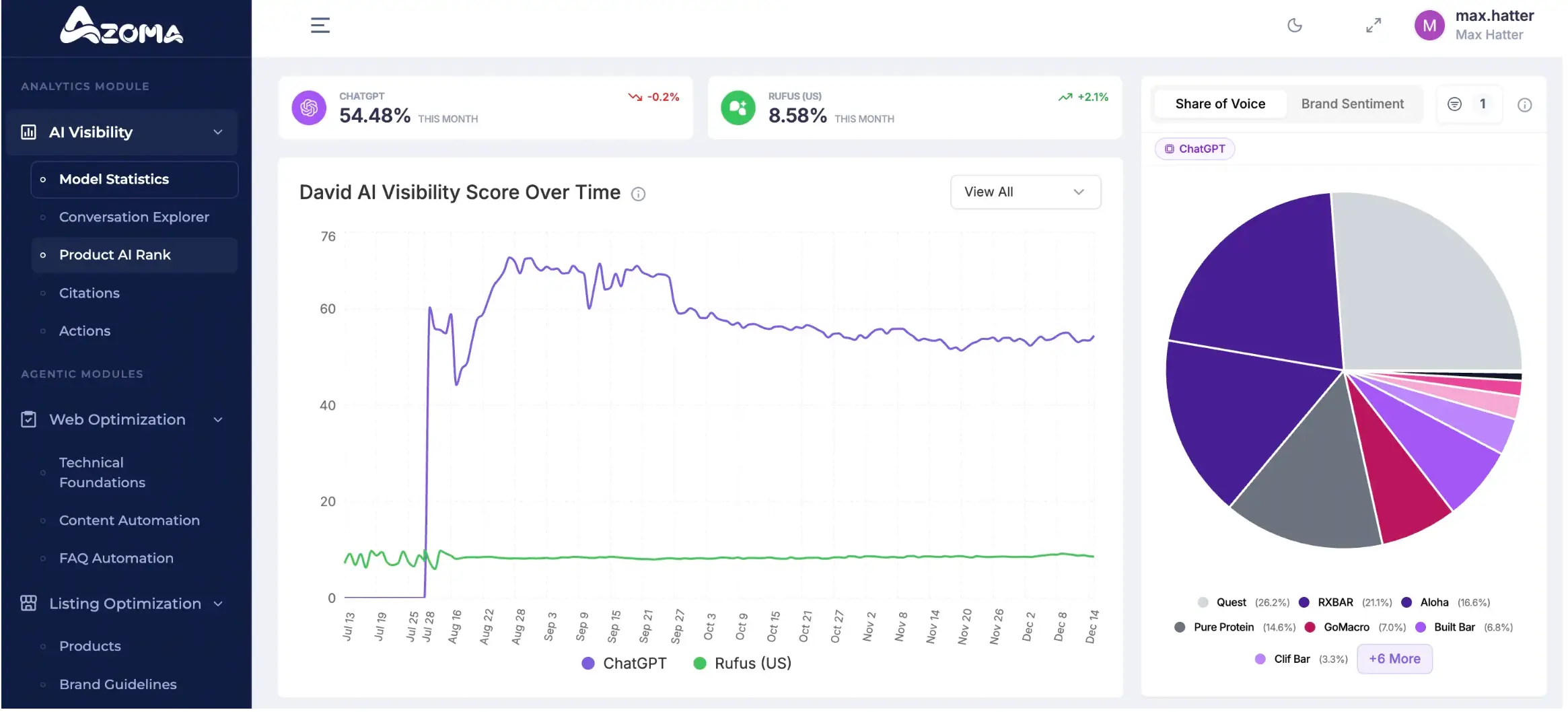
Azoma is an agentic commerce optimisation platform built to help brands appear, appear accurately, and get recommended everywhere shoppers now ask AI what to buy. That spans the retail shopping assistants, including Amazon Rufus and Alexa for Shopping, Walmart Sparky, Google AI Mode, and Siri, and the general answer engines shoppers use earlier in the journey, including ChatGPT, Claude, Perplexity, and Google AI Overviews. Tracking visibility across both sets of surfaces in one platform matters, because a brand researched in Claude or Perplexity and then bought through Rufus is moving through a single journey that most tools only see half of.
Its design follows the 5 Cs directly, which is what separates it from tools that address a single pillar. On Completeness, Azoma audits structured product data across marketplaces and fills the attribute fields shopping agents read, at catalogue scale rather than listing by listing. On Context, it identifies the questions shoppers are asking these agents and generates brand-compliant content that answers them, so listings move beyond keyword coverage. On Citations, it extends into off-platform work, including PR programmes and presence across the forums, listicles, and communities models synthesise from, informed by which citation sources carry weight in a given category. On Correctness, it queries AI outputs systematically across every tracked surface to detect and correct hallucinations and inconsistencies before they reach shoppers. On Customer Acquisition, it ties these inputs, including share of voice and Product AI Rank, through to traffic, conversion, and sales lift measured against control.
The result is one loop rather than a stack of disconnected tools: the same product data, content, citations, and correctness signals feed a single view of how a brand performs from the first research query in ChatGPT to the final recommendation in Sparky. The framework behind it was developed with the Digital Shelf Institute and is documented in Azoma's 5 Cs whitepaper, which is a useful starting point for any brand mapping its own readiness. Teams evaluating where their catalogue stands against the five pillars can request an audit through Azoma to see the gaps before committing to a programme.
Where it wins:
- Coverage across all five Cs in a single platform, rather than one pillar in isolation
- AI visibility tracking across both retail shopping assistants and general answer engines, including ChatGPT, Claude, Perplexity, and Google AI Overviews
- Listing optimisation at scale across Amazon, Walmart, and Target
- Correctness monitoring and off-page citation work joined to the same loop
- A measurement model that connects AI inputs to commercial outputs
Where it stops short:
- The depth of the retail and marketplace tooling is aimed at brand manufacturers, so a pure services or software company with no product catalogue will use a narrower part of it
2. Ecomtent
Best for:
- Ecommerce teams whose main constraint is content and imagery production
- Brands refreshing large catalogues of product visuals and enhanced content
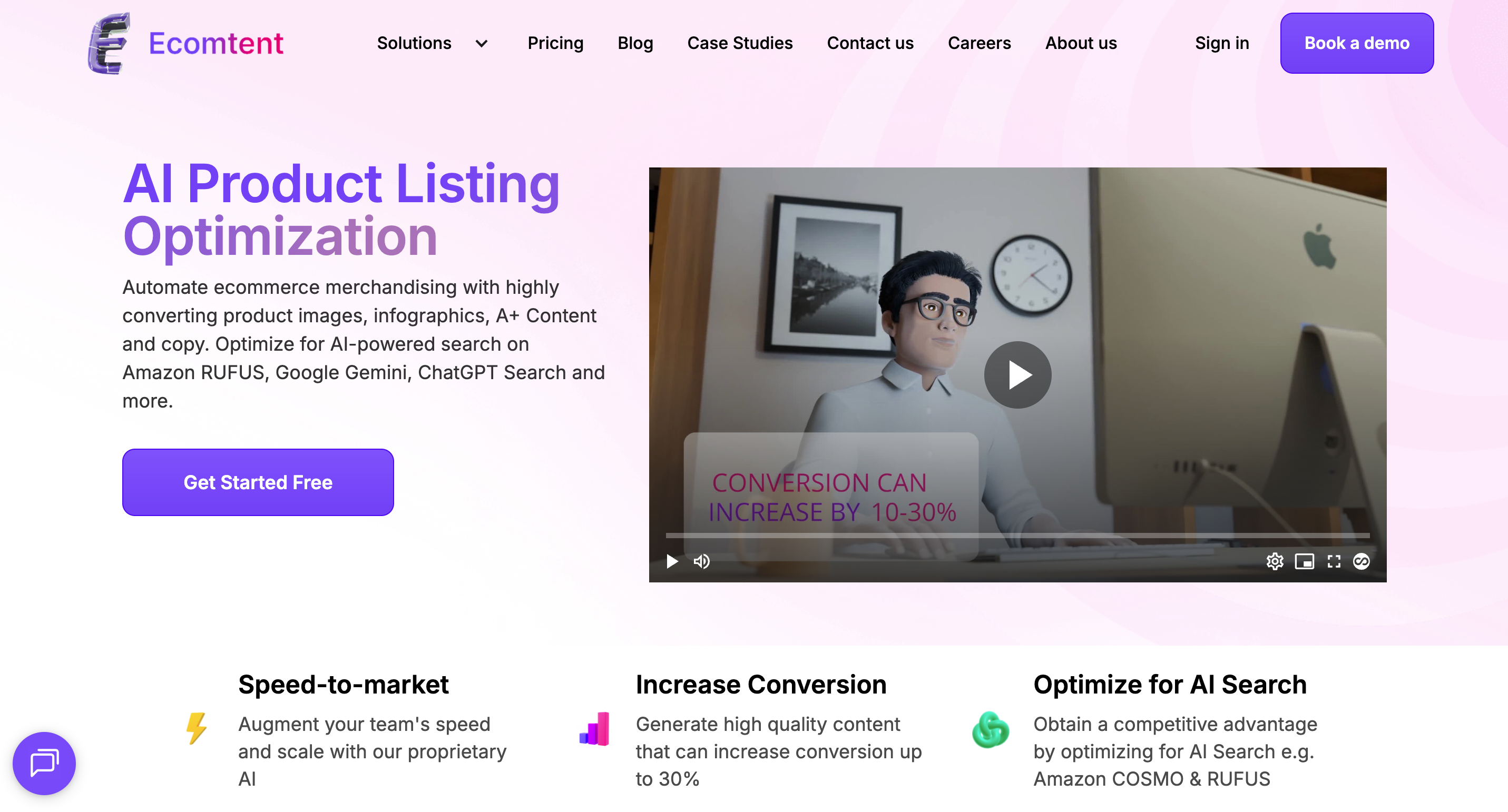
Ecomtent generates ecommerce content, including product imagery and enhanced content modules, at the volume large catalogues demand. For teams that cannot produce visual and written assets fast enough to keep listings current, it removes a real bottleneck and helps address the Context pillar by producing the material that answers shopper questions on a listing.
Its focus is production rather than measurement, so it works best alongside a platform that tracks visibility across surfaces and monitors correctness. On its own it improves the content going onto listings without closing the loop back from how AI agents then represent that content.
Where it wins:
- Fast content and imagery generation at catalogue scale
- A practical fit for teams with a content backlog
Where it stops short:
- Concentrated on creation, without cross-surface visibility tracking, citations, or correctness monitoring
3. Salsify

Best for:
- Brands standardising product data before it reaches retailers
- Teams that need one governed source of truth for attributes
Salsify is a product experience management platform, and its relevance to GEO is structural. It gives brands a single, governed record of product data and syndicates that data out to retail channels, which speaks directly to Completeness. Because shopping agents can only recommend products whose attributes are populated and consistent, clean syndication is a genuine foundation for everything downstream.
What it does not do is measure how AI agents then use that data, or optimise for the questions shoppers ask. It is infrastructure that makes the later pillars possible rather than a tool that acts on them.
Where it wins:
- A reliable single source of truth for structured product data
- Broad syndication across retail channels
Where it stops short:
- Data management rather than answer-engine optimisation or visibility measurement
4. Bazaarvoice

Best for:
- Brands building ratings and reviews at scale
- Teams that want UGC syndicated across a retail network
Bazaarvoice collects ratings, reviews, and other user-generated content and syndicates it across a large retailer network. Its contribution to GEO sits under Citations, because reviews and UGC are among the sources AI shopping agents draw on when they form a view of a product. A strong, well-distributed body of reviews gives models more trustworthy material to synthesise.
It is built around UGC rather than PDP optimisation or GEO measurement, so it strengthens one input to the citation layer without addressing structured data, context, or correctness.
Where it wins:
- Review and UGC collection with wide syndication reach
- Material that feeds the sources AI references in a category
Where it stops short:
- Focused on UGC, not on listing optimisation or cross-surface measurement
5. Pattern

Best for:
- Brands managing marketplace distribution and channel control
- Teams focused on marketplace operations and commerce data
Pattern works across marketplace acceleration, distribution control, and commerce data, helping brands manage how their products are sold across channels. That operational grip on marketplaces is relevant to a commerce programme, and the data it holds can inform where to focus.
Its centre of gravity is marketplace management and paid performance rather than optimisation for AI answer surfaces. It is a useful partner to a GEO programme rather than a GEO platform in its own right.
Where it wins:
- Marketplace operations, distribution control, and commerce data
- Practical channel management for large sellers
Where it stops short:
- Oriented to marketplace management, not to optimisation across AI answer engines
6. BrightEdge
Best for:
- Enterprises with deep web-SEO infrastructure and large content libraries
- Teams layering AI visibility onto an existing SEO stack
BrightEdge is one of the longer-established enterprise SEO platforms, and its strongest capability is entity modelling: organising a brand's pages so engines can place them in a knowledge graph, supported by a large base of data points and keyword history. It has added modules that report how a brand is mentioned and cited across some AI surfaces.
Its heritage is also its limit for commerce GEO. The prompts it works from are largely reverse-engineered from SEO keywords, its coverage skews towards Google and general web search, and it does not reach the retail shopping assistants where CPG decisions are increasingly made. For a brand whose priority is entity structure on the open web it goes deep; for retail AI shopping visibility it leaves gaps.
Where it wins:
- Entity optimisation and knowledge-graph alignment
- Deep SEO infrastructure for large sites
Where it stops short:
- Prompts derived from keywords rather than real shopping-assistant queries
- Coverage weighted to web search rather than retail AI surfaces
Bringing the five pillars together
Most of the tools above do one part of the job well. Product data platforms handle Completeness, content tools support Context, review networks feed Citations, and intelligence tools inform planning. A brand can assemble a programme from these parts, but the seams show quickly: the data lives in one system, the content in another, and by the time anyone tries to prove that AI readiness drove sales, the link back to the original inputs has usually broken.
For CPG and enterprise brands, the value of a platform built around all five Cs is that the same thread runs the whole way through, from the structured data agents read, to the content that answers shopper questions, to the citations that earn trust, to the monitoring that keeps representation accurate, and finally to the commercial outcomes those inputs produce. Azoma is built to hold that chain together across both the retail shopping assistants and the general answer engines, rather than leaving brands to reconnect it by hand.
If you are working out where your catalogue stands against the five pillars, the Azoma 5 Cs whitepaper sets out the framework in full, and the team can run an audit against your listings to show the gaps before you build a programme around them.
If you're an eCommerce brand looking for the perfect GEO tool, get in touch with Azoma here.
Frequently asked questions
What is GEO for ecommerce, and how is it different from GEO for web search?
GEO for ecommerce is the practice of optimising products so they appear, appear accurately, and get recommended inside AI shopping assistants such as Rufus, Alexa for Shopping, and Sparky, as well as the general engines shoppers research in, such as ChatGPT and Perplexity. It differs from general web-search GEO because these assistants read structured product data and marketplace signals, not only web content, so the work includes product attributes and listings rather than pages and citations alone.
How does GEO differ from traditional ecommerce SEO?
Traditional ecommerce SEO optimises for ranking and clicks in a results page. GEO optimises for being selected, cited, and described accurately inside a synthesised answer. The two overlap, since AI still runs searches to build its answers, but the mechanics differ: shopper questions instead of keywords, citations and correctness instead of positions, and a reputation built across reviews, listicles, and forums rather than only on your own listings.
What should a CPG brand prioritise first?
Completeness. Structured product data is the prerequisite, because gaps in attributes limit what every shopping agent can find and recommend downstream. Once the data is populated and consistent, context, citations, and correctness build on top of it, and customer acquisition measurement ties the whole programme to commercial results.
Do we need a dedicated GEO tool, or can our SEO platform handle it?
An SEO platform can add a useful benchmarking layer, but most were built for Google and general web search, with prompts derived from keywords and limited reach into retail shopping assistants. For a brand whose revenue runs through Amazon, Walmart, and Target, a tool built for agentic commerce covers surfaces and product data an SEO suite does not.


.svg)
.svg)
.svg)
.svg)